+237 681 25 6934
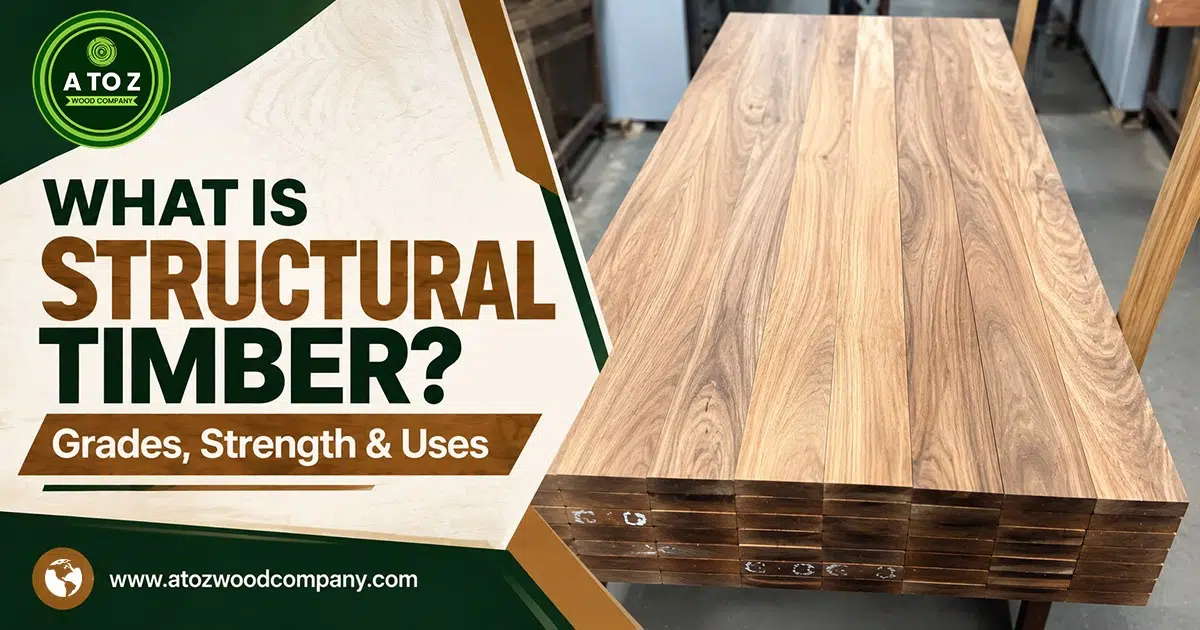
Structural timber is timber selected, graded, and prepared for applications where it is expected to carry loads or contribute to the structural stability of a building or structure. Unlike timber used mainly for decorative purposes, structural timber must meet specific requirements for strength, stiffness, dimensions, moisture content, durability, and defects.
It can be used for beams, columns, roof structures, floor joists, rafters, wall framing, trusses, bridges, timber-frame buildings, and other load-bearing applications.
However, an important point is often overlooked: a timber species is not automatically structural timber simply because it is strong or dense. Structural suitability depends on the grade, dimensions, moisture condition, defects, applicable standards, and the requirements of the particular project.
For timber buyers, builders, architects, and importers, understanding these differences is essential when selecting structural timber.
What Is Structural Timber?
It is solid or engineered timber manufactured, graded, or classified for use in load-bearing construction.
The term generally refers to timber products whose mechanical properties are sufficiently known and controlled to allow them to be considered in structural design.
Structural timber may include:
- Sawn structural timber
- Structural softwood
- Structural hardwood
- Glulam
- Laminated veneer lumber (LVL)
- Cross-laminated timber (CLT)
- Other engineered timber products
Depending on the market and product, structural timber may be visually graded, machine graded, strength classified, or manufactured according to a recognized product standard.
The objective of grading is to identify timber with predictable structural characteristics. Features such as knots, grain deviation, splits, checks, density, slope of grain, and other defects can influence how a piece of timber performs under load.
Why Is Structural Timber Important?
Buildings and other structures are exposed to different types of loads. Timber members may need to resist bending, compression, tension, shear, or combinations of these forces.
For example, a floor joist primarily experiences bending and shear, while a column may experience significant compression. A roof truss can contain members subjected to both tension and compression.
Selecting timber based solely on appearance or species name is therefore not sufficient.
The timber must be appropriate for the intended structural application and comply with the standards and engineering requirements applicable to the project.
Structural Timber Grades Explained
Timber grading is one of the most important concepts to understand when purchasing structural timber.
A grade provides information about the expected structural performance of a piece of timber. Different countries and standards use different grading systems, so grades should not automatically be treated as interchangeable between markets.
What Does Timber Grading Mean?
Timber grading involves evaluating characteristics that can influence structural performance.
Depending on the grading system, these characteristics can include:
- Knots
- Slope of grain
- Checks and splits
- Density
- Growth characteristics
- Resin pockets
- Wane
- Fissures
- Decay
- Insect damage
- Moisture content
- Modulus of elasticity
- Strength-related characteristics
A grading system establishes limits or requirements for these characteristics and places timber into a recognized structural category.
The result is a more predictable material for structural design.
Visual Grading
Visual grading is performed by inspecting timber and assessing visible characteristics that can affect its strength.
A trained grader may examine:
- Knot size and location
- Grain direction
- Splits
- Checks
- Wane
- Distortion
- Decay
- Other visible defects
Visual grading does not mean that the timber is judged simply by whether it looks attractive. Structural visual grading is based on defined criteria related to performance.
A piece with a clear, straight grain may have favorable characteristics, while large knots or severe grain deviation can reduce its structural capacity.
Machine Grading
Machine grading uses equipment to measure properties associated with structural performance.
Machine stress grading can assess characteristics such as stiffness and may then assign timber to a defined strength class according to the applicable standard.
This can provide a more objective approach to structural classification, although the exact process depends on the grading system and product.
What Is C24 Structural Timber?
C24 is a commonly recognized strength class used for structural softwood in certain European grading systems.
The letter C identifies a strength class for softwood, while the number represents the class within the relevant standard.
C24 timber is therefore not a particular tree species.
This distinction is important.
A supplier should not simply describe a random piece of timber as “C24” because it appears strong. The timber must meet the requirements of the applicable grading and classification standard.
Other strength classes exist, and the appropriate class depends on the product, species, grading method, and applicable standard.
C24 Does Not Mean Every Timber Is C24
Different species and timber products have different characteristics. Furthermore, structural classification is affected by grading procedures, manufacturing, dimensions, moisture conditions, and standards.
Consequently, buyers should request appropriate grading or classification documentation when purchasing structural timber for a project.
Structural Timber Strength
The strength of timber is not represented by a single number.
Timber can experience several different types of mechanical loading, and its performance depends on the direction and type of force applied.
Important structural properties include:
| Property | What It Describes |
|---|---|
| Bending strength | Resistance to bending forces |
| Compression strength | Ability to resist compressive loads |
| Tensile strength | Ability to resist pulling forces |
| Shear strength | Resistance to forces acting parallel to a surface |
| Modulus of elasticity | A measure related to stiffness |
| Density | Mass per unit volume and an important physical characteristic |
| Dimensional stability | Resistance to movement caused by moisture changes |
These properties can vary considerably between species and even between individual pieces of the same species.
Bending Strength
Bending strength is particularly important for members such as:
- Beams
- Floor joists
- Rafters
- Some roof members
- Certain bridge components
When a beam carries a load, it bends. The timber must have sufficient structural capacity to withstand the expected loading without excessive failure or deformation.
Compression Strength
Compression occurs when forces push timber together.
Columns and posts are common examples.
Compression performance can be affected by:
- Timber species
- Density
- Defects
- Grain direction
- Member dimensions
- Length
- Moisture
- Connection details
- Structural configuration
Long slender timber members may also be affected by buckling, meaning that simply knowing the compressive strength of the timber itself is not enough to design a column.
Tensile Strength
Tension occurs when a member is pulled apart.
Timber can have significant strength parallel to the grain, but defects and grain deviation can substantially influence performance.
Tension may be important in:
- Trusses
- Structural frames
- Certain connections
- Engineered timber systems
Shear Strength
Shear forces act parallel to a material’s surface or cause adjacent sections to slide relative to one another.
Shear can be important around supports and connections, particularly in beams.
Factors That Affect Structural Timber Strength
Several factors influence the structural performance of timber.
1. Species
Different species have different densities, grain structures, natural durability, stiffness, and strength characteristics.
However, species alone does not establish a structural grade.
2. Knots
Knots are natural features formed where branches develop from the tree.
Large or strategically located knots can affect strength, particularly when they interrupt the straight grain of the timber.
3. Grain Direction
Straight grain is generally desirable for many structural applications.
Significant slope of grain can influence mechanical performance because timber is naturally anisotropic, meaning its properties differ according to direction.
4. Moisture Content
Moisture has a significant influence on timber properties and dimensional movement.
Timber may shrink as it dries and swell as it gains moisture. Excessive or changing moisture conditions can therefore affect both dimensions and performance.
5. Density
Density is an important characteristic associated with many timber properties. Dense species often have different mechanical characteristics from lightweight species, although density alone should not be used to assign a structural grade.
6. Defects and Damage
Decay, insect attack, severe checks, splits, excessive wane, and manufacturing defects can affect structural suitability.
7. Dimensions
The dimensions of a structural member influence how it performs under load.
A timber beam measuring 100 × 200 mm does not behave the same way as a smaller member simply because they are made from the same species.
Moisture Content in Structural Timber
Moisture content is a critical consideration when purchasing and using structural timber.
Freshly harvested timber contains considerably more moisture than properly dried timber. As timber dries, its dimensions can change.
This movement can affect:
- Width
- Thickness
- Length
- Joints
- Connections
- Surface condition
- Dimensional stability
Kiln-Dried Structural Timber
Kiln drying uses controlled temperature, humidity, and airflow to reduce timber moisture content.
The target moisture content should correspond to the intended application and environmental conditions.
For indoor construction, timber may require a different moisture condition than timber intended for an exterior environment.
There is therefore no single moisture-content number that is universally correct for every application.
Buyers should specify the intended use and applicable requirements when ordering timber.
Types of Structural Timber
It can be divided into several broad categories.
| Type | Description | Typical Applications |
|---|---|---|
| Sawn structural timber | Solid timber cut from logs into specified dimensions | Beams, joists, rafters, framing |
| Structural softwood | Softwood graded for structural applications | Framing, roofs, floors, walls |
| Structural hardwood | Hardwood selected and classified for structural use | Beams, posts, bridges, heavy construction |
| Glulam | Layers of timber bonded together | Large beams, columns, roof structures |
| LVL | Laminated veneer-based structural product | Beams, joists, headers, structural framing |
| CLT | Cross-laminated timber panels | Walls, floors, roofs, mass timber buildings |
The correct product depends on the design, span, loading, environment, availability, and applicable building standards.
Structural Softwood
Softwoods are widely used for structural construction in many markets.
Common examples include various grades of:
- Pine
- Spruce
- Fir
- Douglas fir
- Other commercially available softwood species
Structural softwood is frequently used for:
- Wall framing
- Roof framing
- Floor joists
- Rafters
- Trusses
- General building frames
One of the advantages of softwood is its relatively low weight compared with many dense hardwoods, combined with good strength-to-weight characteristics in appropriate grades.
However, the actual performance depends on the specific species, grade, dimensions, moisture condition, and standard.
Structural Hardwood
Hardwoods can also be used for structural applications.
Certain hardwood species provide high density, strength, stiffness, and natural durability, making them suitable for demanding applications when properly graded and specified.
Potential applications include:
- Heavy beams
- Posts and columns
- Bridges
- Outdoor structures
- Heavy-duty flooring
- Marine-related construction in appropriate applications
- Architectural structural elements
Examples of hardwoods that may be encountered in structural timber markets include species such as:
- Teak
- Iroko
- Doussie
- Azobé
- Padauk
- Oak
- Cumaru
This does not mean that every piece of these species is automatically approved for structural use.
The timber still needs to meet the applicable requirements for its intended application.
Engineered Structural Timber
Engineered timber products have expanded the possibilities for timber construction.
Instead of relying exclusively on a single solid-sawn member, engineered products are manufactured by bonding or arranging timber components in controlled configurations.
Glulam
Glulam, or glued laminated timber, consists of multiple timber laminations bonded together.
It is commonly used for:
- Large beams
- Columns
- Roof structures
- Long-span architectural structures
- Curved structural elements
One advantage of glulam is that large structural members can be manufactured from smaller timber components.
LVL
Laminated veneer lumber is manufactured from thin wood veneers assembled and bonded to form a structural product.
LVL is commonly used for:
- Beams
- Headers
- Joists
- Structural framing
- Long structural members
Its manufacturing process allows the product to have relatively consistent properties compared with many naturally variable solid timber members.
CLT
Cross-laminated timber consists of layers of timber boards arranged in alternating directions and bonded together.
CLT panels can be used for:
- Floors
- Walls
- Roofs
- Modular construction
- Mass timber buildings
Its panel construction makes it different from conventional solid-sawn structural timber.
Common Uses of Structural Timber
It is used across residential, commercial, industrial, agricultural, and infrastructure projects.
1. Roof Structures
Structural timber is widely used for:
- Rafters
- Roof beams
- Trusses
- Purlins
- Other roof framing members
The timber must be appropriately graded and sized for the loads and span involved.
2. Floor Joists
Floor joists support flooring systems and transfer loads to beams, walls, or other supporting members.
Important considerations include:
- Span
- Spacing
- Loading
- Timber grade
- Member dimensions
- Deflection requirements
3. Beams
Timber beams can transfer loads across openings or between supporting points.
They are used in:
- Houses
- Commercial buildings
- Timber-frame construction
- Agricultural structures
- Bridges
- Architectural projects
Large spans may require engineered timber such as glulam or LVL.
4. Columns and Posts
Timber posts and columns transfer vertical loads toward the foundation.
For these applications, factors such as compression, buckling, connections, moisture exposure, and durability can be important.
5. Wall Framing
Structural timber framing can form the load-bearing framework of walls.
This is particularly common in timber-frame and lightweight construction systems.
6. Bridges
Timber has a long history of use in bridge construction.
Modern timber bridges may use solid structural timber, glulam, or other engineered timber products depending on the design.
7. Agricultural Buildings
Structural timber can be used in:
- Barns
- Storage buildings
- Shelters
- Agricultural roof systems
- Other farm structures
The appropriate timber specification depends heavily on environmental exposure and expected loads.
8. Commercial Buildings
Timber construction is also used in commercial buildings, particularly where architects and engineers incorporate mass timber or engineered timber systems.
Structural Timber vs Non-Structural Timber
| Feature | Structural Timber | Non-Structural Timber |
|---|---|---|
| Primary purpose | Load-bearing or structural function | Decorative or general-purpose applications |
| Grading | Usually subject to structural grading/classification | May use appearance or other grades |
| Strength requirements | Defined according to applicable standards | May not require structural classification |
| Defect requirements | Controlled according to grade | Requirements may focus more on appearance |
| Typical applications | Beams, joists, rafters, posts | Cladding, furniture, decorative work |
| Documentation | May require grading/classification documentation | Depends on product and market |
| Engineering use | Can be specified for structural design when compliant | Should not be assumed suitable for structural design |
A visually attractive board is not necessarily structural timber.
Similarly, a timber with excellent natural durability is not automatically suitable as a load-bearing member.
Structural Timber vs Engineered Timber
Structural timber and engineered timber overlap but are not identical terms.
Structural timber describes timber intended or classified for structural use.
Engineered timber describes timber products manufactured through engineered processes such as laminating, bonding, or cross-layering.
Therefore, engineered timber can be structural timber, but structural timber does not necessarily have to be engineered.
For example:
- A graded solid-sawn beam can be structural timber.
- A glulam beam can be engineered structural timber.
- An LVL beam can be engineered structural timber.
- A decorative timber board is neither necessarily structural nor engineered.
How to Choose Structural Timber
Choosing structural timber should begin with the requirements of the project rather than the appearance of the timber.
1. Identify the Application
Determine whether the timber will be used for:
- Beam
- Column
- Joist
- Rafter
- Truss
- Wall framing
- Bridge
- Outdoor structure
- Other load-bearing component
2. Specify Dimensions
Provide exact:
- Thickness
- Width
- Length
- Quantity
- Required tolerances
For volume calculations, AtoZ Wood Company’s Timber CBM Calculator can help buyers estimate cubic-meter volume.
3. Specify the Grade
Do not simply ask for a particular species.
Where structural performance is required, specify the required structural grade or classification according to the applicable standard.
4. Check Moisture Requirements
Specify whether the timber needs to be:
- Air dried
- Kiln dried
- Supplied at a particular moisture range
- Suitable for interior conditions
- Suitable for exterior exposure
5. Consider Durability
For outdoor or moisture-exposed structures, durability becomes especially important.
Natural durability and preservative treatment may both be relevant, depending on the species and application.
6. Check Certification and Documentation
Depending on the market and project, buyers may require:
- Structural grading documentation
- Inspection reports
- Certificate of Origin
- Phytosanitary documentation
- FSC certification
- PEFC certification
- Treatment certificates
- Other market-specific documentation
The exact documents required depend on the destination country, product, species, and application.
Why Timber Species Alone Does Not Determine Structural Performance
One of the most common misconceptions in timber purchasing is that a strong species automatically equals strong structural timber.
Consider two pieces of the same species.
One may have:
- Large knots
- Significant grain deviation
- High moisture
- Checks or splits
- Poor dimensions
The other may have:
- Better grain
- Fewer defects
- Controlled moisture
- Appropriate dimensions
- A recognized structural grade
Although both come from the same species, their structural characteristics may differ.
This is why professional structural timber purchasing considers species + grade + dimensions + moisture + defects + standards + application.
Common Mistakes When Buying Structural Timber
- Buying Only by Species Name
As discussed above, species does not automatically determine structural grade. - Ignoring Moisture Content
Timber that is too wet for its intended application may experience additional movement as it dries.
- Not Specifying the Grade
A buyer asking for “strong timber” leaves too much room for interpretation.
A recognized grade or specification is much more useful. - Assuming Decorative Timber Is Structural
Appearance-grade timber is not automatically suitable for load-bearing construction.
- Ignoring Defects
Large knots, severe grain deviation, decay, splits, and other defects can affect structural performance.
- Assuming All Standards Are Interchangeable
A grading system used in one market may not directly correspond to another system.
Always confirm which standard applies. - Buying Without Documentation
For commercial construction and international timber purchasing, appropriate documentation can help establish product specifications, origin, inspection status, and compliance requirements.
Structural Timber for International Buyers
A clear purchase specification should ideally include:
- Species
- Product type
- Grade
- Dimensions
- Lengths
- Moisture content
- Quantity
- Treatment requirements
- Packaging requirements
- Destination port
- Required documentation
- Applicable standards
For international orders, buyers may also need to consider import regulations, phytosanitary requirements, legality documentation, certification, inspection, and destination-country requirements.
A detailed specification reduces misunderstandings between the buyer and supplier.
AtoZ Wood Company supplies timber products for international buyers and can discuss product specifications, dimensions, quantities, processing requirements, and relevant documentation according to the order and destination market.
Structural Timber Dimensions and Volume
It is commonly purchased according to dimensions and cubic-meter volume.
For example, a buyer may specify:
100 mm × 200 mm × 6,000 mm
The total volume depends on the number of pieces ordered.
Buyers working with mixed dimensions can use the Timber Dimension Converter to convert common timber measurements.
A timber’s weight can also be useful when planning transportation, handling, and logistics. AtoZ Wood Company’s Timber Weight Calculator can assist with timber weight estimation.
For comparing characteristics across different species, the Wood Species Comparison tool can also be useful as an initial reference.
These tools are useful for estimation and comparison, but they should not replace engineering calculations or certified structural data.
What Makes Good Structural Timber?
There is no single characteristic that makes a piece of timber “good” for every structural application.
A suitable structural timber product generally needs to match the requirements of its intended use.
Important characteristics may include:
- Appropriate structural grade
- Adequate strength
- Suitable stiffness
- Controlled moisture content
- Appropriate dimensions
- Acceptable defects
- Suitable durability
- Correct treatment where required
- Traceable origin
- Appropriate documentation
- Compliance with applicable standards
The requirements for a roof rafter are not necessarily identical to those for a bridge beam or heavy timber column.
The application must therefore guide the specification.
Structural Timber and Sustainable Construction
Timber is a renewable construction material when forests are responsibly managed and harvested within appropriate legal and environmental frameworks.
Responsible timber sourcing can include:
- Legal forest management
- Controlled harvesting
- Reforestation and regeneration
- Traceability
- Protection of biodiversity
- Responsible labour practices
- Community engagement
- Certification where applicable
For international buyers, certification schemes such as FSC and PEFC can provide additional information about responsible forest management and supply-chain practices, depending on the specific certified product and claim.
However, sustainability certification and structural grading serve different purposes.
Certification relating to forest management does not itself establish structural strength.
Likewise, a structural grade does not by itself establish that timber came from a responsibly managed forest.
Both aspects may matter, but they answer different questions.
Conclusion
Structural timber is more than simply strong timber.
It is timber selected and specified according to the requirements of a structural application. Its performance can depend on species, grade, strength characteristics, moisture content, dimensions, grain, defects, durability, manufacturing, and applicable standards.
For buyers, one of the most important lessons is to avoid purchasing structural timber based solely on a species name. A complete specification should identify the product, dimensions, required grade, moisture condition, intended application, and relevant documentation.
For international timber procurement, clear specifications also help suppliers understand exactly what the buyer requires and reduce potential problems during production, inspection, shipping, and delivery.
AtoZ Wood Company supplies a range of timber products for international markets, with product specifications and documentation determined according to the species, product, order requirements, and destination market.
When structural timber is being considered for an actual building or engineered structure, the final selection, sizing, connections, and load calculations should always follow the applicable building standards and be verified by the responsible structural professional.