+237 681 25 6934
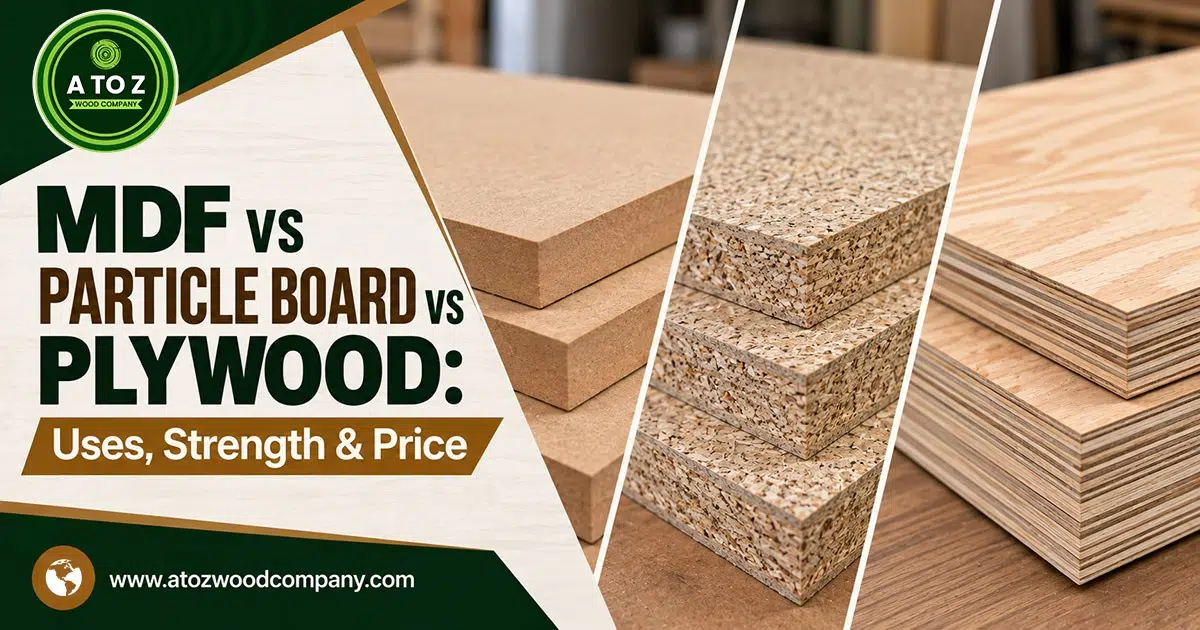
Choosing the right wood-based panel can make a significant difference to the strength, appearance, durability and cost of a furniture or interior project. MDF, particle board and plywood may look similar when they are sold as flat sheets, but they are manufactured differently and perform differently in real-world applications.
So, MDF vs Particle Board vs Plywood — which one should you choose?
The answer depends on what you are building, how much strength it needs, whether it will be exposed to moisture, the type of finish required and your budget.
MDF is known for its smooth, uniform surface and excellent machining characteristics. Particle board is often selected for cost-effective furniture, cabinets and shelving. Plywood, with its cross-laminated veneer construction, is widely used where strength, dimensional stability and structural performance are important.
Understanding these differences before buying can help prevent problems later, particularly with cabinets, shelves, furniture, doors and applications exposed to changing humidity.
MDF vs Particle Board vs Plywood at a Glance
| Feature | MDF | Particle Board | Plywood |
|---|---|---|---|
| Basic material | Refined wood fibres | Wood particles/chips | Thin wood veneers |
| Manufacturing | Fibres bonded under heat and pressure | Particles bonded under heat and pressure | Veneers cross-laminated and bonded |
| Surface | Very smooth and uniform | Relatively smooth, depending on grade and finish | Natural veneer appearance or finished surface |
| Machining | Excellent | Good | Good |
| Painting | Excellent | Requires suitable preparation | Good, depending on grade |
| Screw holding | Good when correctly specified and installed | Generally suitable for appropriate applications | Generally excellent |
| Structural applications | Limited to appropriate grades/applications | Generally non-structural applications | Wide range of structural applications |
| Moisture performance | Depends heavily on grade | Depends heavily on grade | Depends on grade and exposure classification |
| Typical furniture use | Cabinets, doors, mouldings, furniture | Cabinets, shelving, furniture | Furniture, cabinets, construction |
| Cost | Usually moderate | Often economical | Varies widely by species, grade and construction |
| Best known for | Smoothness and machining | Economy and efficient manufacturing | Strength and versatility |
The comparison should always be made between products of comparable grade and specification. MDF, particle board and plywood are not single uniform products. Their performance can vary according to density, thickness, adhesive system, veneer or fibre quality, manufacturing process and intended use.
What Is MDF?
MDF stands for Medium Density Fiberboard.
MDF is an engineered wood panel manufactured from wood fibres combined with a resin or suitable bonding system and consolidated under heat and pressure. The resulting board has a relatively homogeneous structure with a flat, smooth and uniform surface.
Unlike plywood, MDF does not have visible layers of veneer. Its fibre-based composition gives it a consistent surface that can be particularly useful for machining, routing, moulding, painting and decorative finishing.
MDF is commonly used in interior furniture, kitchen cabinets, doors, mouldings, millwork, shelving, wall panels and other applications where a smooth and consistent substrate is important.
Advantages of MDF
1. Smooth surface
One of MDF’s most noticeable characteristics is its smooth, uniform surface. This makes it suitable for painting, laminating, veneering and other finishing processes.
For painted furniture and interior components, a consistent surface can be a major advantage.
2. Excellent machining characteristics
MDF can be routed, shaped and machined into detailed profiles. This is one reason it is widely used for decorative mouldings, cabinet components and intricate interior work.
3. Consistent structure
Because MDF is made from refined wood fibres rather than layers of veneer, it has a relatively uniform composition. This makes it useful where predictable machining and finishing are required.
4. Good for painted furniture
MDF is frequently selected for painted doors, cabinets, decorative panels and mouldings because of its smooth face.
5. Wide range of applications
MDF can be found in residential furniture, office furniture, kitchen cabinetry, interior doors, mouldings, wall panels and retail fixtures.
Disadvantages of MDF
MDF is not automatically suitable for every environment.
Standard MDF products can be vulnerable to moisture, and prolonged exposure to water can cause dimensional changes and deterioration. Moisture-resistant MDF products are available, but the specification should be checked rather than assuming that all MDF has the same moisture performance.
MDF is also relatively heavy compared with some alternatives. Edges may require suitable treatment depending on the application, and fasteners should be selected and installed appropriately.
For structural applications, the specific product grade and engineering requirements must be considered rather than treating ordinary MDF as a substitute for structural plywood.
What Is Particle Board?
Particle board is another engineered wood panel, but instead of primarily using refined fibres, it is manufactured from wood particles of different sizes that are bonded with resin or another binder under heat and pressure.
The particles can include wood chips, shavings and other suitable wood residues.
Particle board is widely used in furniture and interior manufacturing because it can provide a cost-effective panel substrate with consistent dimensions and useful machining characteristics.
It is commonly found in office furniture, residential furniture, kitchen cabinets, shelving, countertops and other interior applications.
Advantages of Particle Board
1. Cost-effective
One of the biggest reasons manufacturers use particle board is its ability to provide an economical panel solution.
For large-volume furniture production, material efficiency can have a significant effect on the overall cost of a product.
2. Efficient use of wood resources
Particle board can incorporate wood particles and manufacturing residues, making it a useful engineered panel product.
3. Suitable for furniture manufacturing
Particle board is commonly used as a substrate for laminated furniture, cabinets, shelving and other interior products.
4. Good surface for decorative finishes
When properly manufactured and finished, particle board can be laminated, veneered or otherwise surfaced for furniture and interior applications.
5. Consistent manufacturing
Industrial particle board is manufactured to specified physical and dimensional requirements, with different products designed for different end uses.
Disadvantages of Particle Board
Particle board performance depends considerably on its grade and intended application.
Standard particle board should not simply be treated as an exterior structural panel. Moisture exposure is an important consideration, and products intended for environments with increased moisture need to be selected accordingly.
The edges can also require appropriate protection or finishing, particularly in furniture applications where water may reach exposed edges.
For heavily loaded shelves or structural applications, the panel’s thickness, span, support arrangement and grade should be considered rather than relying on the material name alone.
What Is Plywood?
Plywood is an engineered wood panel manufactured by bonding thin wood veneers together, normally with adjacent layers arranged with their grain directions oriented differently.
This cross-laminated construction is one of the reasons plywood can provide a strong and dimensionally stable panel.
Plywood is available in many species, grades, thicknesses and constructions. Depending on the specification, it can be used for furniture, cabinetry, flooring, wall and roof sheathing, industrial applications and other demanding projects.
Unlike MDF and particle board, plywood can retain a natural wood appearance when manufactured with suitable face veneers.
Advantages of Plywood
1. Strength
Plywood is widely used where structural performance and strength are important. Its layered construction allows the panel to distribute loads across different directions.
2. Good dimensional stability
Cross-laminated veneer construction helps reduce some of the movement associated with solid wood.
However, plywood is still a wood product and responds to changes in environmental moisture. Correct grade selection, installation and moisture management remain important.
3. Excellent fastening performance
Plywood is widely valued for fastening applications. Its veneer structure can provide good nail and screw-holding performance when the correct panel and fastening method are used.
4. Versatility
Plywood is available in many different grades and constructions. A furniture-grade decorative plywood and a structural sheathing panel are not interchangeable products.
5. Natural appearance
High-quality face veneers can provide an attractive natural wood appearance for furniture, wall panels, doors and other decorative applications.
Disadvantages of Plywood
Plywood can be more expensive than particle board or some MDF products, depending on species, grade, thickness, construction and market conditions.
The quality of plywood can also vary considerably. Buyers should look at the actual grade, veneer quality, number of plies, bonding classification and intended application rather than purchasing solely based on the word “plywood.”
Some lower-grade plywood products may contain visible defects or surface imperfections and may require additional finishing.
MDF vs Particle Board: What Is the Difference?
MDF and particle board are both engineered wood panels, but the structure of the two materials is different.
MDF is made primarily from wood fibres. Particle board is made from wood particles of different sizes.
This difference affects the surface, machining characteristics, density profile and typical applications.
MDF generally provides a smoother and more homogeneous surface, making it particularly attractive for painted furniture, mouldings and detailed machining.
Particle board is commonly used where economical panel construction and efficient manufacturing are priorities.
For example, a decorative painted cabinet door may benefit from MDF’s smooth surface and machining characteristics, while a laminated furniture carcass may use particle board as a cost-effective substrate.
Neither should automatically be considered superior in every application.
MDF vs Plywood: Which Is Better?
The answer depends on the project.
If the priority is a smooth surface for painting and detailed machining, MDF can be very useful.
If the priority is structural strength, fastening performance and a wider range of demanding applications, an appropriately specified plywood product may be more suitable.
For example, consider a built-in interior cabinet with painted doors. MDF may be an attractive option for the doors because of its smooth surface.
For a heavy-duty cabinet carcass, furniture component or application requiring greater structural performance, plywood may be considered.
The correct comparison should therefore be based on the exact grade, thickness and application rather than asking whether MDF or plywood is universally better.
Particle Board vs Plywood: What Is the Difference?
Particle board and plywood differ substantially in their construction.
Particle board is made from wood particles bonded together. Plywood is made from layers of wood veneer bonded in a cross-laminated structure.
Plywood is widely used for structural and load-bearing applications because suitable grades are engineered and rated for these purposes.
Particle board is more commonly associated with furniture, shelving, countertops, cabinets and interior applications.
This does not mean that every plywood panel is suitable for every structural application or that every particle board product performs identically. Product specifications must always be checked.
For a budget-conscious furniture project where the board will be laminated and properly supported, particle board can be a practical choice.
For applications requiring greater strength, span capability or fastening performance, the appropriate plywood specification may offer advantages.
Which Is Stronger: MDF, Particle Board or Plywood?
Strength is not one single property.
A panel can be evaluated for bending strength, stiffness, internal bond, screw holding, dimensional stability and other characteristics.
Plywood is widely used for structural applications because its cross-laminated veneer construction can provide strength and stiffness in different directions.
MDF has a homogeneous fibre structure and can offer useful strength and machining characteristics for interior applications.
Particle board can also be manufactured in different grades with different physical and mechanical properties.
Therefore, simply saying “plywood is stronger” without identifying the grade, thickness and test condition can be misleading.
For a real project, compare the technical specifications of the actual products being considered.
Which Is Better for Kitchen Cabinets?
All three materials can be found in kitchen applications, but the right choice depends on the component and environmental conditions.
MDF for Kitchen Cabinets
MDF is commonly used for painted cabinet doors and decorative components because of its smooth surface and machining characteristics.
For kitchens, however, moisture exposure must be considered. Where moisture-resistant MDF is specified, the product should be selected according to the manufacturer’s intended use.
Particle Board for Kitchen Cabinets
Particle board is widely used for cabinet carcasses and furniture components, especially when laminated surfaces are applied.
Proper edge sealing and protection are important in areas where water could reach the panel.
Plywood for Kitchen Cabinets
Plywood can be used for cabinet carcasses, doors, shelves and other components where strength and fastening performance are priorities.
The grade and surface finish should match the intended application.
Which Is Better for Wardrobes?
For wardrobes, MDF and particle board are both commonly used.
MDF is particularly useful when the wardrobe includes painted doors, routed profiles or decorative details.
Particle board can be an economical choice for laminated wardrobe carcasses and shelves.
Plywood may be selected when greater structural performance, screw holding or durability is required.
The best choice depends on the design, load, finish and budget.
Which Is Better for Shelves?
Shelf performance depends on more than the board material.
The important factors include:
- Board thickness
- Shelf width
- Distance between supports
- Expected load
- Fastening method
- Panel grade
- Moisture conditions
A long shelf carrying heavy books requires a different specification from a small decorative shelf.
Plywood can be advantageous where strength and span performance are important. MDF and particle board can work effectively for many furniture shelves when thickness, support and loading are properly designed.
Which Is Better for Painting?
MDF is generally a strong choice when a very smooth, uniform painted surface is required.
Its homogeneous surface can be machined and finished effectively, making it popular for painted doors, mouldings, decorative panels and furniture components.
Plywood can also be painted, particularly when a suitable face grade and preparation are selected.
Particle board can be painted, but surface preparation and edge treatment may require additional attention.
The final result depends heavily on sanding, priming, coating system, edge preparation and manufacturing quality.
Which Is Better for Humid Environments?
This is an area where buyers should be particularly careful.
There is no simple rule that every plywood product is moisture-resistant or that every MDF and particle board product will fail in humid conditions.
Manufacturers produce panels with different moisture-performance characteristics.
For MDF and particle board, products may be manufactured with properties designed for particular moisture conditions.
For plywood, exposure or bond classifications are important. Some plywood is designed for exterior exposure, while other classifications are intended for limited moisture exposure rather than permanent outdoor conditions.
The important lesson is simple:
Never choose a panel for a humid or wet environment based only on the word MDF, particle board or plywood. Check the actual product specification.
MDF vs Particle Board vs Plywood for Furniture
Furniture manufacturers often use more than one panel type in the same product.
For example:
- MDF may be used for painted doors.
- Particle board may be used for laminated cabinet carcasses.
- Plywood may be used for stronger structural components or premium furniture.
- Veneered plywood may be used where both appearance and strength are important.
This approach allows manufacturers to match each component to its performance requirements.
A premium furniture product does not necessarily need to use one material everywhere. Smart material selection means using the appropriate board for each component.
MDF vs Particle Board vs Plywood: Price Considerations
Price is an important factor, but comparing prices without comparing specifications can lead to the wrong decision.
The cost of MDF, particle board and plywood can vary according to:
- Thickness
- Dimensions
- Density
- Wood species
- Grade
- Surface finish
- Number of plies
- Adhesive system
- Moisture resistance
- Decorative overlay
- Manufacturer
- Quantity purchased
- Market and destination
Particle board is often selected for economical furniture applications.
MDF may provide a good balance between surface quality and cost for interior applications.
Plywood can command a higher price when higher-grade veneers, stronger construction or specific exposure classifications are required.
Instead of asking only, “Which is cheapest?”, consider the total project cost, including machining, finishing, installation, maintenance and potential replacement.
How to Choose Between MDF, Particle Board and Plywood
Before buying a panel, answer these questions.
1. What are you building?
A cabinet door, bookshelf, kitchen carcass, wall panel and structural floor panel have very different requirements.
2. Will the material be exposed to moisture?
If yes, specify a product designed for the expected moisture conditions.
3. Does the panel need to carry a load?
If the answer is yes, structural performance should become a primary selection criterion.
4. What type of finish do you need?
For a smooth painted finish, MDF may be attractive.
For natural wood appearance, suitable plywood with a quality face veneer may be preferable.
For laminated furniture, particle board can be a practical substrate.
5. How will it be fastened?
Consider screws, nails, hinges, brackets and other hardware.
The panel’s thickness, density and construction can affect fastening performance.
6. What thickness do you need?
A thicker panel is not automatically the best choice. Thickness should be matched to the load, span and construction method.
7. What is your budget?
Material cost should be evaluated alongside performance and installation requirements.
8. What grade are you buying?
This may be the most important question.
“MDF,” “particle board” and “plywood” describe broad product categories. Always request the technical specification of the exact panel.
Common Mistakes When Buying Wood-Based Panels
Choosing by price alone
The cheapest panel may not be the most economical choice if it fails to meet the project’s requirements.
Assuming all plywood is the same
Plywood can vary significantly by species, veneer grade, number of plies, adhesive system, thickness and exposure classification.
Assuming all MDF is moisture-resistant
Standard MDF and moisture-resistant MDF should not be treated as identical products.
Ignoring the edges
Edges can be particularly vulnerable to moisture and mechanical damage. Proper edge treatment can be important in furniture and cabinetry.
Using the wrong thickness
A panel that works perfectly for a small cabinet door may not perform adequately as a long, heavily loaded shelf.
Ignoring storage conditions
Wood-based panels respond to changes in moisture. Proper storage, handling and acclimatization can help reduce dimensional problems.
What Should You Check Before Buying MDF, Particle Board or Plywood?
For commercial buyers, importers, furniture manufacturers and contractors, request clear product specifications before placing an order.
Depending on the application, useful information may include:
- Product type
- Grade
- Thickness
- Panel dimensions
- Density
- Surface finish
- Core construction
- Moisture-performance classification
- Mechanical properties
- Formaldehyde-emission information where relevant
- Applicable standards
- Packaging details
- Quantity available
- Production lead time
- Shipping requirements
- Inspection requirements
- Required documentation
For international purchasing, also confirm the destination country’s import requirements and any documents needed for customs clearance.
MDF vs Particle Board vs Plywood: Which One Should You Choose?
There is no single winner in the MDF vs Particle Board vs Plywood comparison.
Each material has a different role.
Choose MDF when:
You need a smooth, uniform panel for painting, machining, mouldings, decorative furniture or interior applications.
Choose particle board when:
You need an economical engineered panel for suitable furniture, shelving, cabinets, countertops or interior applications.
Choose plywood when:
You need a versatile panel with strong structural characteristics, good fastening performance and a wide choice of grades and applications.
The most important consideration is not simply the name printed on the product label. It is whether the specific panel specification matches the job.
A good buyer considers strength, moisture exposure, thickness, finish, load, installation method, expected service life and budget before making a decision.
Looking for MDF, Particle Board or Plywood?
AtoZ Wood Company supplies a range of wood products and wood-based materials for international buyers. When requesting a quotation, provide the product type, grade, thickness, dimensions, quantity and destination port so the appropriate product and supply requirements can be assessed.
For larger or international orders, buyers should also confirm the required specifications, documentation, packaging and shipping requirements before placing an order.