+237 681 25 6934
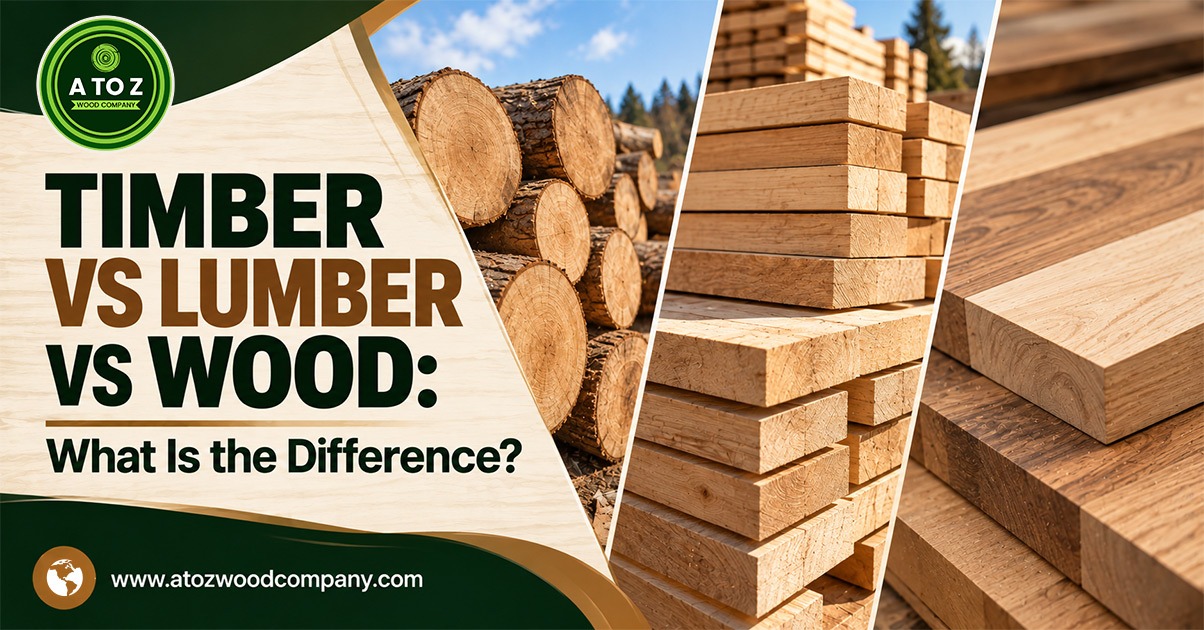
If you work with wood products, you have probably come across the terms wood, timber, and lumber. They are often used interchangeably, but they do not always mean exactly the same thing.
The confusion becomes even greater when buying wood internationally because terminology can change between countries. A product that one supplier calls timber may be called lumber by a buyer in North America, even when both are referring to a similar sawn wood product.
So, what is the difference between timber vs lumber vs wood?
In simple terms, wood is the broad natural material obtained from trees, while timber and lumber are terms commonly used for wood that has been harvested and processed into commercially useful products. However, the exact meaning of timber and lumber depends on regional usage and industry context.
Understanding these terms can help buyers, builders, architects, manufacturers, and importers communicate more clearly and specify the right wood product.
What Is Wood?
Wood is a natural material obtained primarily from the stems, branches, and roots of trees. It is a biological material made up largely of cellulose, hemicellulose, and lignin.
Wood has been used for thousands of years because it combines strength, workability, durability, appearance, and versatility.
There are two broad categories of wood commonly discussed in the timber industry:
- Hardwoods, generally obtained from broadleaf trees such as teak, iroko, oak, and mahogany.
- Softwoods, generally obtained from coniferous trees such as pine, spruce, and cedar.
The terms hardwood and softwood refer primarily to botanical classification. They do not simply mean that every hardwood is physically harder than every softwood.
Wood can be used in many forms, including:
- Logs
- Sawn boards
- Beams
- Slabs
- Flooring
- Decking
- Furniture
- Doors and windows
- Veneer
- Plywood
- Engineered wood products
- Packaging materials
- Structural components
Therefore, wood is the broadest term of the three.
What Is Timber?
The word timber can have several meanings depending on the country and context.
In the forest and wood-products industry, timber commonly refers to trees or wood that is suitable for processing and commercial use. It can also refer to processed wood products such as sawn boards, beams, planks, and other construction materials.
For example, a timber supplier may offer:
- Timber logs
- Rough-sawn timber
- Kiln-dried timber
- Structural timber
- Timber beams
- Timber boards
- Timber slabs
- Decking timber
- Flooring timber
The term is particularly common in the United Kingdom, Australia, New Zealand, and many international markets.
In some contexts, timber can also refer to standing trees or harvested logs before they are converted into finished products. Consequently, the exact meaning should be understood from the product description and specifications.
For international trade, simply saying “timber” is often not enough. A buyer should specify the species, dimensions, grade, moisture content, finish, quantity, and intended application.
What Is Lumber?
Lumber generally refers to wood that has been processed by sawing logs into boards, planks, beams, or other standard dimensions.
The term is especially common in the United States and Canada.
For example, construction companies in North America commonly use terms such as:
- Dimensional lumber
- Hardwood lumber
- Softwood lumber
- Rough lumber
- Finished lumber
- Structural lumber
A sawmill converts logs into lumber by cutting them into specific sizes. The resulting material can then be dried, graded, planed, treated, or further machined.
Lumber may be sold in standard dimensions for construction or in specialized dimensions for furniture, flooring, cabinetry, and other applications.
This is one reason why a North American buyer may ask for “lumber” while a supplier in another market may describe the same type of material as “sawn timber.”
Timber vs Lumber vs Wood: Key Differences
The simplest way to understand the three terms is to look at their general usage.
| Feature | Wood | Timber | Lumber |
|---|---|---|---|
| Basic meaning | Natural material from trees | Wood or trees intended for commercial/industrial use, depending on context | Processed wood, commonly sawn into boards, planks, or beams |
| Scope | Broadest term | Varies by region and industry | More specific commercial term |
| Regional usage | Worldwide | Common in UK, Australia, New Zealand and international trade | Particularly common in the US and Canada |
| Can refer to trees/logs? | Yes | Sometimes | Generally refers to processed wood |
| Common products | Logs, boards, veneer, plywood, etc. | Logs, boards, beams, planks, slabs | Boards, dimensional lumber, beams, planks |
| Common applications | Furniture, construction, manufacturing and more | Construction, furniture, flooring, decking and manufacturing | Construction, furniture, cabinetry and manufacturing |
These definitions are useful as a general guide, but terminology is not completely standardized across every market.
Timber vs Lumber: Are They the Same?
Timber and lumber can refer to very similar processed wood products, but the terms are not universally interchangeable.
The biggest difference is often regional terminology.
A supplier in the UK or many international markets may advertise sawn timber, while a buyer in the United States may search for sawn lumber or simply lumber.
For example, consider a kiln-dried oak board produced from a sawmill. One company may describe it as:
Kiln-dried oak timber
Another may describe the same general product as:
Kiln-dried oak lumber
The important information for the buyer is not just the terminology. The buyer should confirm:
- Species
- Thickness
- Width
- Length
- Grade
- Moisture content
- Surface finish
- Quantity
- Treatment
- Intended use
This is particularly important in international timber trade, where terminology can differ between supplier and buyer.
Timber vs Wood: What Is the Difference?
Wood is the broader natural material, while timber generally describes wood or trees considered suitable for commercial use or processing.
For example, the wood of a teak tree is a natural material. Once harvested and processed into commercially traded boards, beams, slabs, or other products, it may be marketed as teak timber.
However, “timber” can also refer to logs or trees in certain contexts.
This means that the distinction is more about context and usage than a completely different material.
Timber is wood, but not every reference to wood necessarily means timber.
For example, someone might talk about:
- Wood fibres
- Wood grain
- Wood density
- Wood anatomy
- Wood chemistry
These are general references to the material.
A timber merchant, on the other hand, might discuss:
- Timber dimensions
- Timber grades
- Timber moisture content
- Timber treatment
- Timber prices
- Timber shipments
The context changes the meaning.
Lumber vs Wood: What Is the Difference?
The relationship between lumber and wood is similar.
Lumber is processed wood intended for commercial use, particularly in construction and manufacturing.
Wood is the raw natural material. Lumber is a manufactured wood product created by processing logs.
For example:
Tree → Log → Sawn lumber → Dried lumber → Finished product
The original tree contains wood. After harvesting and processing, the resulting boards and beams may be sold as lumber.
Lumber can be further processed through:
- Kiln drying
- Planing
- Grading
- Treatment
- Profiling
- Moulding
- Finger-jointing
- Laminating
The resulting products may be used in residential construction, commercial buildings, furniture, flooring, doors, cabinetry, and many other applications.
How Does a Tree Become Timber or Lumber?
Understanding the production process makes the difference between these terms easier to understand.
1. Forest Management
The process begins with responsible forest management.
Trees may be grown in managed forests or sourced from other legally controlled forest areas. Species, growth conditions, age, diameter, and intended application can influence harvesting decisions.
Responsible sourcing is important because timber production should balance commercial requirements with long-term forest management.
2. Harvesting
When a tree reaches an appropriate stage for harvesting, it is carefully felled according to applicable forestry requirements.
The tree is then converted into logs suitable for transportation and processing.
3. Log Preparation
At the sawmill, logs are inspected and prepared for sawing.
Factors such as:
- Diameter
- Length
- Straightness
- Knots
- Defects
- Species
- Intended end use
can influence how the log is processed.
4. Sawing
The logs are cut into boards, planks, beams, slabs, or other dimensions.
This is the stage at which a round log becomes a range of commercially useful sawn wood products.
5. Sorting and Grading
The sawn material can be sorted according to dimensions, quality, appearance, strength requirements, and intended use.
Different markets may use different grading systems.
6. Drying
Wood may be air-dried or kiln-dried depending on the product and required moisture content.
Drying helps reduce moisture and can improve dimensional stability for many applications.
The appropriate moisture content depends on species, product type, climate, end use, and applicable standards.
7. Planing and Machining
Some products are sold rough-sawn, while others are planed or machined.
A product may be supplied as:
- Rough-sawn
- Sawn and calibrated
- Planed
- S4S
- Moulded
- Profiled
8. Treatment
Depending on the species and intended application, wood may receive preservative or protective treatment.
Treatment requirements vary according to exposure conditions and the intended use of the material.
9. Packaging and Transportation
The finished timber or lumber is bundled and prepared for transportation.
For international shipments, packaging, documentation, container loading, phytosanitary requirements, and destination-country regulations can all become important.
Hardwood vs Softwood Timber and Lumber
Another common source of confusion is the difference between hardwood and softwood.
Hardwood
Hardwoods generally come from angiosperm or broadleaf trees.
Examples include:
- Teak
- Iroko
- Sapele
- Doussie
- Padauk
- Oak
- Beech
- Merbau
Hardwoods are widely used for:
- Flooring
- Furniture
- Decking
- Doors
- Joinery
- Exterior applications
- Marine applications
- Decorative products
Softwood
Softwoods generally come from gymnosperm or coniferous trees.
Examples include:
- Pine
- Spruce
- Cedar
- Fir
Softwoods are widely used for:
- Construction
- Framing
- Roofing
- Packaging
- Furniture
- Interior applications
- Panels
- General woodworking
Importantly, hardwood does not automatically mean harder and softwood does not automatically mean softer. Physical properties vary significantly between species.
Common Types of Timber and Lumber
Timber and lumber can be supplied in many different forms.
Logs
Logs are round sections of harvested trees before they are sawn into boards and other products.
Rough-Sawn Timber
Rough-sawn timber is cut to size but retains the textured surface produced by the saw.
Sawn Boards
Boards are rectangular pieces of wood produced by sawing logs.
Beams
Beams are larger structural wood sections commonly used in construction and heavy applications.
Planks
Planks are relatively wide, thick sawn pieces used for construction, flooring, furniture, and other applications.
Slabs
Slabs are broad sections of wood, often retaining natural edges or distinctive grain patterns. They are popular for furniture and decorative applications.
Dimensional Lumber
Dimensional lumber is commonly associated with standardized sizes used in North American construction.
Flooring Timber
Flooring boards are processed to specific dimensions and profiles for installation as floors.
Decking
Decking timber is selected and processed for outdoor applications where exposure to weather and moisture must be considered.
Engineered Wood Products
Not every wood-based product is solid timber or lumber.
Products such as plywood, MDF, particle board, and laminated panels are manufactured by processing wood fibres, veneers, strands, or other wood components.
This distinction is important when specifying materials for a project.
Timber and Lumber Terminology Around the World
One of the main reasons for confusion is that wood terminology changes between markets.
United States
“Lumber” is the common term for many sawn wood products, particularly construction materials.
Canada
“Lumber” is also widely used, especially for construction products.
United Kingdom
“Timber” is commonly used for wood products used in construction and other applications.
Australia and New Zealand
“Timber” is also a common term for many sawn wood and construction products.
International Trade
International timber suppliers may use terms such as:
- Sawn timber
- Sawn wood
- Lumber
- Hardwood timber
- Hardwood lumber
- Softwood timber
- Softwood lumber
Consequently, buyers should avoid relying on terminology alone.
The product specification is more important than the word used to describe it.
Why the Difference Matters When Buying Timber or Lumber
If you are purchasing wood for a construction or manufacturing project, simply asking for “wood” is usually not specific enough.
A professional timber inquiry should include detailed specifications.
1. Wood Species
Specify the exact species required.
Examples include:
- Teak
- Iroko
- Okoume
- Okan
- Padauk
- Sapele
- Pine
- Spruce
Species selection affects appearance, density, durability, workability, and suitability for different applications.
2. Dimensions
Specify:
- Thickness
- Width
- Length
For large commercial orders, dimensional tolerances should also be discussed.
3. Grade
Grade requirements can affect appearance, strength, defects, and price.
The appropriate grading system depends on the species, product, market, and intended use.
4. Moisture Content
Moisture content is important because wood is hygroscopic and exchanges moisture with its surrounding environment.
Specify whether you require:
- Air-dried material
- Kiln-dried material
- A particular moisture-content range
5. Finish
Specify whether the material should be:
- Rough-sawn
- Planed
- S4S
- Moulded
- Calibrated
- Sanded
6. Quantity
For commercial purchases, quantity may be specified in:
- Cubic metres
- Pieces
- Square metres
- Linear metres
- Container quantities
7. Treatment
If the material will be exposed to insects, moisture, or outdoor conditions, treatment requirements should be clearly specified.
8. Certification and Documentation
Depending on the destination and project, buyers may require documentation such as:
- Certificate of Origin
- Phytosanitary Certificate
- Inspection documents
- Forest certification
- CITES documentation where applicable
- Other destination-specific documents
Requirements vary according to species, origin, product, and destination.
Timber vs Lumber for International Trade
For international buyers, the distinction between timber and lumber is less important than providing a precise product specification.
For example, instead of simply writing:
“I need 100 CBM of African timber.”
A more useful inquiry would specify:
Species: Iroko
Product: Sawn timber
Dimensions: 50 × 150 × 3,000 mm
Grade: Commercial/required grade
Moisture: Kiln dried, specified moisture range
Quantity: 100 CBM
Destination: Specific destination port
Treatment: If required
Documents: Required certificates and inspection documents
This reduces misunderstandings between buyers and suppliers.
For international purchases, the same product may be called sawn timber, sawn lumber, or sawn wood depending on the market.
The technical specification remains the key.
What Should You Specify When Buying Timber?
Whether you call the product timber or lumber, provide as much technical information as possible.
A professional purchase request should ideally include:
- Species
- Product type
- Dimensions
- Quantity
- Grade
- Moisture content
- Finish
- Treatment
- End use
- Destination
- Required certification
- Packaging requirements
For large orders, buyers should also confirm shipping terms, loading arrangements, documentation, payment conditions, and delivery schedules.
Timber vs Lumber vs Wood: A Simple Example
Imagine a teak tree growing in a managed forest.
The material inside the tree is wood.
After harvesting, the tree becomes a log.
The log is transported to a sawmill and cut into boards.
Depending on the market, those boards may be called timber or lumber.
The boards can then be dried, graded, planed, treated, and manufactured into flooring, furniture, decking, doors, or other products.
So the terms describe different aspects of the same broader material and its commercial journey.
Tree → Wood → Log → Sawn Timber/Lumber → Finished Wood Product
This is why understanding context is more useful than trying to create an absolute separation between the words.