+237 681 25 6934
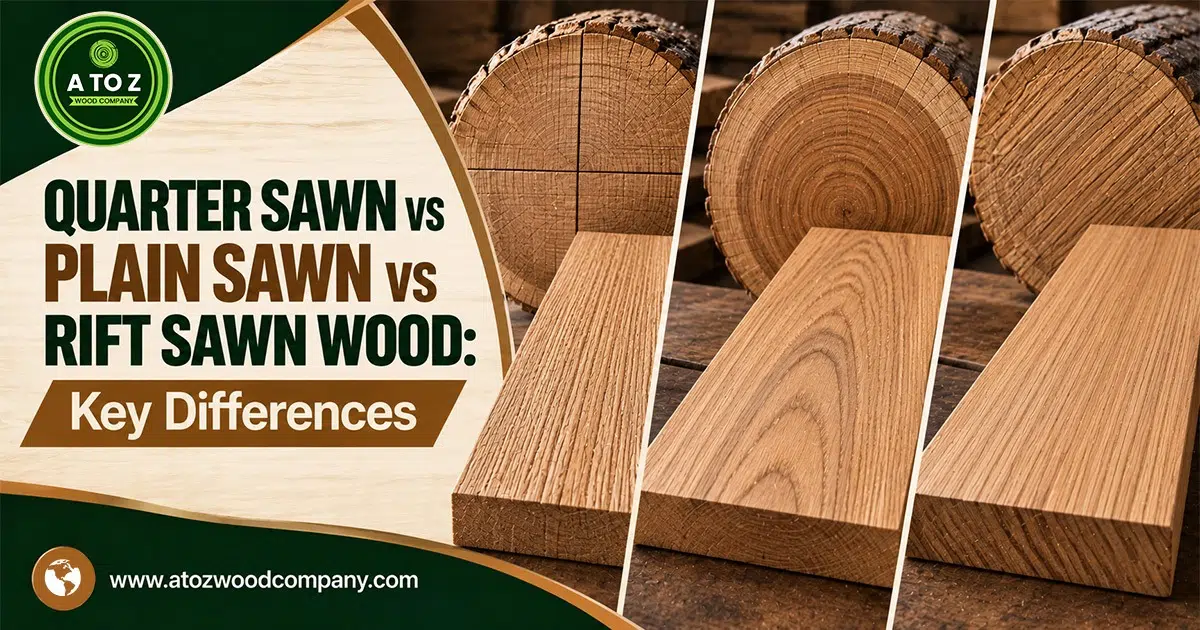
When timber is cut from a log, the direction of the cut has a major effect on the appearance, stability, grain pattern, yield, and cost of the resulting boards. This is why understanding quarter sawn vs plain sawn vs rift sawn wood is important when selecting timber for furniture, flooring, cabinetry, doors, architectural millwork, and other woodworking applications.
The three methods are not simply different ways of cutting a log. Each produces a different relationship between the growth rings and the face of the board. That relationship affects how the timber responds to changes in moisture and how its grain appears after machining and finishing.
For timber buyers, manufacturers, architects, and woodworkers, choosing between plain sawn, quarter sawn, and rift sawn timber depends on the intended application, desired appearance, dimensional stability, available timber yield, and budget.
What Is Plain Sawn Wood?
Plain sawn wood, also called flat sawn or through-and-through sawn timber, is produced by making a series of relatively parallel cuts through the log. It is one of the most common and efficient methods of converting a log into boards.
The growth rings generally meet the broad face of a plain sawn board at a relatively shallow angle, often producing the characteristic cathedral or flame-shaped grain pattern associated with flat sawn timber.
How Plain Sawing Works
The log is positioned and boards are cut along its length in a way that produces relatively wide boards from a large portion of the log.
Because the cutting process makes efficient use of the log, plain sawing can provide good board yield compared with more specialized sawing methods.
Characteristics of Plain Sawn Timber
Plain sawn timber commonly features:
- Cathedral-shaped grain patterns
- Broad, attractive faces
- Efficient log utilization
- Good availability
- Generally lower production cost than specialized cuts
- Greater tangential movement than quarter or rift sawn boards
The exact appearance depends on the species, log characteristics, cutting pattern, moisture content, and grade.
Advantages of Plain Sawn Wood
The major advantage is efficiency.
Plain sawing can produce relatively wide boards while making good use of the log. This makes it practical for many commercial timber applications.
Other advantages include:
- Attractive natural grain
- Availability in wider boards
- Efficient production
- Generally lower cost
- Suitable for many furniture applications
- Suitable for general construction and joinery
Disadvantages of Plain Sawn Wood
The main consideration is dimensional movement.
Because of the orientation of the growth rings, plain sawn boards generally experience more tangential movement than quarter sawn boards when their moisture content changes.
This does not make plain sawn timber unsuitable. Proper drying, grading, machining, installation, and moisture control remain important.
Common Applications
Plain sawn timber is widely used for:
- Furniture
- Tables
- General joinery
- Doors
- Wall paneling
- Flooring
- Cabinets
- Construction
- Interior woodworking
- Decorative boards
What Is Quarter Sawn Wood?
Quarter sawn wood is produced by first dividing the log into quarters and then sawing boards from the resulting sections. The growth rings are positioned at a much steeper angle to the board face than in typical plain sawn timber.
Quarter sawing is particularly valued when dimensional stability and a distinctive grain appearance are important.


How Quarter Sawing Works
The log is divided into quarters, generally with the cuts arranged so that boards are sawn with the growth rings oriented approximately perpendicular to the broad face.
The precise cutting pattern can vary depending on the sawmill and desired product.
In some species, quarter sawing also exposes prominent ray fleck or medullary ray patterns, particularly in species such as oak.
Characteristics of Quarter Sawn Timber
Quarter sawn boards are generally known for:
- More vertical or steeply oriented growth rings
- Greater dimensional stability across the board width
- Reduced cupping tendency compared with typical flat sawn boards
- Straight-looking grain
- Potentially prominent ray patterns in certain species
- Lower yield compared with highly efficient plain sawing
- Higher production cost in many situations
Advantages of Quarter Sawn Wood
One of the principal reasons to choose quarter sawn timber is dimensional stability.
The orientation of the growth rings can reduce certain forms of movement across the board’s width. This can be valuable for applications where maintaining a relatively stable shape is important.
Quarter sawn timber can also produce an attractive, relatively straight grain appearance.
Disadvantages of Quarter Sawn Wood
The main disadvantages are production efficiency and cost.
Quarter sawing generally requires a more deliberate cutting process and can produce narrower boards and more waste than an efficient plain sawing pattern.
As a result, quarter sawn timber can command a higher price, depending on species, grade, dimensions, availability, and market conditions.
Common Applications
Quarter sawn timber is often selected for:
- Premium furniture
- Flooring
- Cabinetry
- Doors
- Architectural millwork
- Fine joinery
- Musical instruments
- Decorative paneling
- High-end interior applications
What Is Rift Sawn Wood?
Rift sawn wood is produced by cutting timber so that the growth rings are positioned at a relatively consistent steep angle to the board face, commonly close to 90 degrees.
The objective is to obtain boards with a very straight and consistent grain appearance while minimizing certain forms of grain variation across the face.


How Rift Sawing Works
Rift sawing involves cutting through the log in a pattern designed to produce boards with growth rings at a steep angle to the board face.
The cutting arrangement can result in relatively straight grain and narrow boards.
Compared with plain sawing, this method generally sacrifices some log yield and efficiency in exchange for particular grain characteristics.
Characteristics of Rift Sawn Timber
Rift sawn boards are generally associated with:
- Very straight grain
- Consistent appearance
- Steep growth-ring orientation
- Good dimensional stability
- Reduced tendency toward certain types of warping
- Lower yield than efficient plain sawing
- Higher production costs
Advantages of Rift Sawn Wood
The straight grain is one of the major reasons manufacturers select rift sawn timber.
For modern furniture, cabinetry, architectural interiors, and projects where consistent grain direction is important, rift sawn boards can provide a clean and uniform appearance.
Disadvantages of Rift Sawn Wood
Rift sawing is less efficient in terms of timber recovery than plain sawing.
The process can also produce narrower boards and more offcuts. Consequently, rift sawn timber is often more expensive.
The exact price difference depends on species, dimensions, grade, availability, and market conditions.
Common Applications
Rift sawn timber can be suitable for:
- High-end furniture
- Cabinet doors
- Modern cabinetry
- Architectural millwork
- Fine joinery
- Flooring
- Decorative wall panels
- Furniture components requiring consistent grain
Quarter Sawn vs Plain Sawn vs Rift Sawn: Key Differences
The most important difference between these three methods is the orientation of the growth rings relative to the board face.
| Feature | Plain Sawn | Quarter Sawn | Rift Sawn |
|---|---|---|---|
| Typical grain appearance | Cathedral/flame patterns | Straighter grain, possible ray fleck | Very straight, uniform grain |
| Growth-ring orientation | More tangential | Steeper/radial | Steep, relatively consistent |
| Dimensional stability | Moderate | High | High |
| Tangential movement | Relatively higher | Relatively lower | Relatively lower |
| Board width | Often wider | Often narrower | Often narrower |
| Log yield | Generally high | Generally lower | Generally lower |
| Production efficiency | High | Moderate/lower | Lower |
| Typical cost | Lower | Higher | Higher |
| Appearance | Varied and decorative | Straight with species-dependent features | Very consistent and straight |
| Common uses | General furniture, flooring, joinery | Furniture, flooring, cabinetry | Fine furniture, cabinetry, millwork |
These are general characteristics rather than universal rules. Species, moisture content, board dimensions, drying quality, grading, and processing can significantly affect actual performance.
Quarter Sawn vs Plain Sawn Wood
The difference between quarter sawn vs plain sawn wood is particularly important when dimensional stability and appearance are priorities.
Plain sawn boards generally provide better log utilization and wider boards. They can also show distinctive cathedral grain patterns that many furniture manufacturers intentionally use as a design feature.
Quarter sawn timber, by comparison, generally provides a steeper growth-ring orientation and can offer greater dimensional stability across the board width.
Plain Sawn
Choose plain sawn timber when priorities include:
- Wider boards
- Efficient timber utilization
- Attractive cathedral grain
- General-purpose woodworking
- Cost efficiency
Quarter Sawn
Quarter sawn timber can be considered when priorities include:
- Greater dimensional stability
- Straighter grain
- Reduced cupping tendency
- Premium furniture
- Fine joinery
- Particular decorative grain characteristics
Neither method is universally superior. The appropriate choice depends on the project.
Quarter Sawn vs Rift Sawn Wood
The difference between quarter sawn vs rift sawn wood can be less obvious visually because both can produce relatively straight grain.
The major distinction is in the sawing pattern and the resulting relationship between the growth rings and board face.
Quarter sawn timber can expose distinctive medullary ray patterns in species where those rays are prominent. Rift sawn timber is generally selected when a more uniform straight-grained appearance is desired.
For high-end cabinetry, rift sawn boards can be particularly attractive when consistency between adjacent components is important.
Quarter sawn boards may be preferred where both stability and characteristic species-specific grain features are desired.
Plain Sawn vs Rift Sawn Wood
Plain sawn vs rift sawn wood represents a more noticeable difference in both appearance and production approach.
Plain sawn timber usually offers greater board width and better recovery from the log. Its grain can feature prominent cathedral patterns.
Rift sawn timber sacrifices some efficiency to produce boards with a more consistent straight-grain appearance.
This makes the two methods suitable for different design objectives.
If the goal is efficient production and a traditional natural grain appearance, plain sawn timber may be appropriate.
If consistent straight grain is a major design requirement, rift sawn timber may be considered.
How Sawing Method Affects Wood Grain
The sawing method determines how the growth rings appear on the finished board.
In plain sawn boards, the growth rings intersect the face at a shallower angle, often creating cathedral-shaped patterns.
In quarter sawn boards, the growth rings are oriented more steeply, resulting in a straighter appearance. In suitable species, prominent ray patterns can become visible.
Rift sawn boards are generally characterized by particularly consistent straight grain.
The difference becomes especially noticeable after planing, sanding, staining, and finishing.
For decorative applications, grain direction can therefore be as important as the basic timber species.
How Sawing Method Affects Timber Stability
Wood is a hygroscopic material. It gains and loses moisture as environmental conditions change.
As its moisture content changes, wood can shrink or swell. However, this movement is not identical in every direction.
The orientation of the growth rings therefore matters.
Plain sawn boards typically experience greater tangential movement than radial movement. This can contribute to changes in board shape, including cupping, when moisture conditions fluctuate.
Quarter sawn and rift sawn boards generally have growth-ring orientations that reduce certain types of dimensional movement across the board face.
However, sawing method is only one part of timber stability.
Proper kiln drying, moisture conditioning, storage, machining, installation, and environmental control are also important.
Which Sawing Method Produces the Most Stable Wood?
Quarter sawn and rift sawn timber are generally associated with greater dimensional stability than typical plain sawn timber because of their growth-ring orientation.
However, “stability” should not be treated as a single property.
A timber board’s actual behavior depends on:
- Wood species
- Moisture content
- Drying quality
- Board thickness
- Board width
- Grain characteristics
- Defects
- Installation conditions
- Indoor or outdoor environment
A properly dried plain sawn board can perform very well, while poorly dried quarter sawn timber can still experience problems.
Which Sawing Method Is Best for Furniture?
The appropriate sawing method for furniture depends on the furniture design and the desired appearance.
Plain sawn timber is commonly suitable for tables, general furniture components, and applications where broad boards and distinctive grain patterns are desirable.
Quarter sawn timber can be useful for furniture requiring greater dimensional stability and particular grain characteristics.
Rift sawn timber is often attractive for modern furniture and cabinetry where straight, consistent grain is a major design objective.
For large furniture components, manufacturers should also consider board width, thickness, moisture content, grade, and expected environmental conditions.
Which Sawing Method Is Best for Flooring?
All three sawing methods can be used for flooring, depending on the species and product specification.
Plain sawn flooring can provide attractive cathedral grain and broad visual patterns.
Quarter sawn flooring can offer greater dimensional stability and a relatively straight grain appearance.
Rift sawn flooring provides a particularly consistent grain direction and can create a clean contemporary appearance.
The choice should also consider installation method, moisture conditions, wear requirements, timber species, finish, and board dimensions.
Which Sawing Method Is Best for Cabinets and Joinery?
For cabinetry and fine joinery, grain consistency and dimensional stability can be particularly important.
Quarter sawn timber can be useful where stability and distinctive grain features are desired.
Rift sawn timber is often selected for cabinet doors and visible components where straight and consistent grain is part of the design.
Plain sawn timber remains suitable for many cabinet components and can offer attractive grain at a potentially lower cost.
Which Sawing Method Is Best for Decorative Timber?
The answer depends on the desired visual effect.
If the goal is a prominent cathedral grain, plain sawn timber can be an excellent choice.
If the project calls for straighter grain combined with species-specific ray patterns, quarter sawn timber may be appropriate.
If the design requires a very consistent straight grain, rift sawn timber can be considered.
The species itself also has a major influence on the final appearance.
How Sawing Method Affects Timber Price
The sawing method can influence timber price because different cutting patterns produce different levels of recovery, labor requirements, board dimensions, and usable material.
Plain sawing is generally efficient and can produce wider boards from the log.
Quarter sawing requires a more specialized cutting arrangement and can reduce recovery.
Rift sawing can require even greater selectivity to obtain its characteristic grain orientation.
Therefore, quarter sawn and rift sawn timber can cost more than comparable plain sawn material.
However, pricing is not determined by sawing method alone. Species, grade, dimensions, moisture content, certification, availability, order quantity, processing, and destination can all influence the final price.
Why Is Quarter Sawn Timber More Expensive?
Quarter sawn timber can be more expensive because the cutting process can reduce recovery compared with efficient plain sawing.
The production process may also require additional handling and sorting.
The premium can be justified for projects where dimensional stability, appearance, or particular grain characteristics are important.
For a buyer, the right question is therefore not simply “Which timber costs less?” but “Which sawing pattern provides the characteristics required for the application?”
Why Is Rift Sawn Timber More Expensive?
Rift sawing generally prioritizes grain orientation and consistency rather than maximum timber recovery.
The process can result in narrower boards and more material that does not become the desired finished product.
This can increase production costs.
Rift sawn timber is therefore often specified for applications where its straight and consistent grain justifies the additional cost.
How to Choose Between Plain Sawn, Quarter Sawn and Rift Sawn Timber
Before ordering timber, consider the following factors.
1. Start With the End Use
Determine whether the timber will be used for:
- Furniture
- Flooring
- Cabinets
- Doors
- Windows
- Wall panels
- Architectural millwork
- Structural applications
- Decorative components
2. Consider Grain Appearance
Decide whether you want:
- Cathedral grain
- Straight grain
- Uniform grain
- Ray patterns
- A particular species-specific appearance
3. Consider Dimensional Stability
If the timber will experience significant moisture fluctuations, the orientation of the grain should be considered alongside proper drying and moisture management.
4. Consider Board Dimensions
Plain sawing can be advantageous when wider boards are required.
Quarter and rift sawn timber may produce narrower boards depending on the log and cutting pattern.
5. Consider Budget
Specialized sawing methods can increase the cost of timber.
Compare the additional cost against the performance and appearance benefits required for the project.
6. Specify Moisture Content
Sawing method does not replace proper timber drying.
For interior applications, buyers should specify an appropriate moisture-content range based on the intended environment and product requirements.
7. Discuss Specifications With the Supplier
When purchasing commercial quantities, provide the supplier with:
- Species
- Dimensions
- Quantity
- Grade
- Moisture requirement
- Sawing method
- Surface finish
- End use
- Destination
This allows the supplier to quote material that actually matches the project requirements.
Conclusion: Quarter Sawn vs Plain Sawn vs Rift Sawn Wood
Understanding quarter sawn vs plain sawn vs rift sawn wood helps buyers make better timber specifications.
Plain sawn timber is efficient, versatile, and often provides attractive cathedral grain. Quarter sawn timber offers a steeper growth-ring orientation and is valued for dimensional stability and distinctive grain characteristics. Rift sawn timber focuses on consistent, straight grain and is often selected for high-end furniture, cabinetry, and architectural applications.
The right choice ultimately depends on the combination of species, end use, appearance, dimensions, moisture conditions, stability requirements, availability, and budget.
For commercial timber orders, it is useful to specify the required sawing method along with the species, dimensions, grade, moisture content, quantity, and intended application. This gives the supplier a clearer understanding of the material required and helps ensure that the timber is suitable for its final use.