+237 681 25 6934
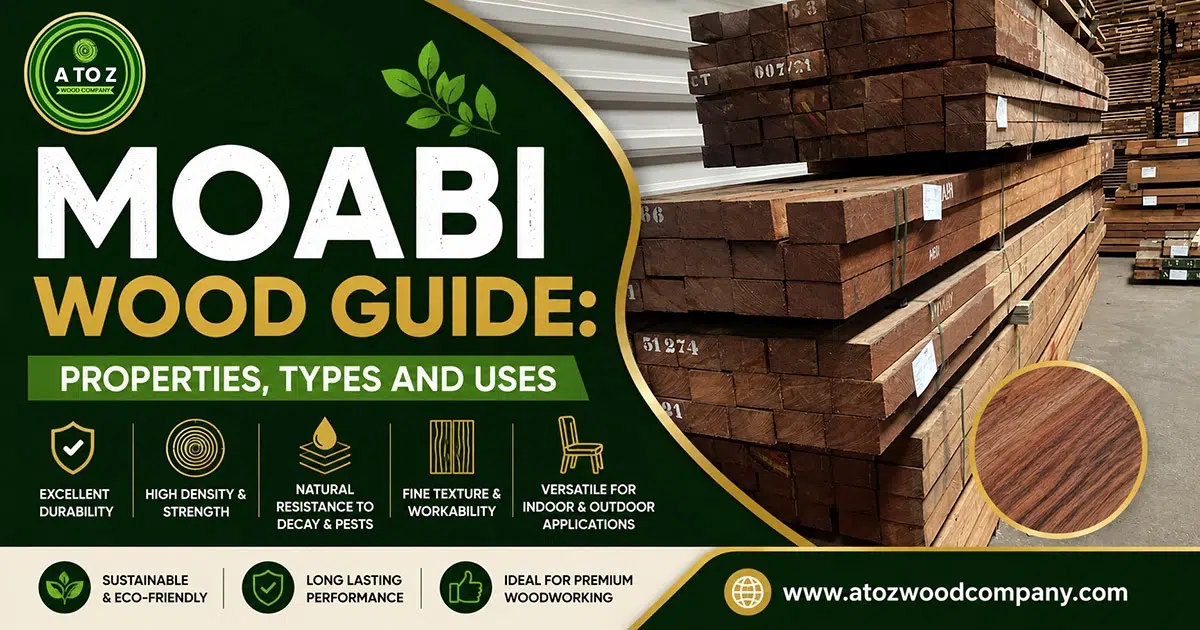
Moabi is one of Africa’s most popular tropical hardwoods, valued for its high density, strength, natural durability, and attractive appearance. Obtained from the Baillonella toxisperma tree found in the tropical regions of Africa, Moabi is considered ideal for premium construction, furniture, marine applications, and specialty projects. Also known as African Pearwood, Moabi stands out for its natural durability and dimensional stability.
In this guide, AtoZ Wood Company explores the physical properties, types, and common uses of Moabi wood.
What is Moabi Wood?
Moabi is a tropical hardwood sourced from Baillonella toxisperma trees in the Sapotaceae family and found in the rainforests of Central and West Africa, particularly Cameroon, Gabon, the Republic of the Congo, and Nigeria. The Moabi trees are exceptionally tall (sometimes over 60 meters) and have very large trunk diameters.
Maobi is a high-value commercial timber acknowledged for its remarkable physical properties and exotic appearance. The heartwood is reddish-brown.
Physical Properties of Moabi Wood
Moabi is classified as a dense, heavy hardwood with excellent strength.
Average Dried Weight: 54 lbs/ft3 (860 kg/m3)
Janka Hardness: 1,790 lbf (7,960 N)
(Source: www.wood-database.com)
Despite its high density and hardness, it is fairly easy to work with. Defects such as checking and warping are common during drying but can be reduced through extra care. Seasoned moabi is extremely stable, even under challenging conditions.
Appearance and Grain
One of Moabi’s main attractions is its premium natural appearance.
The heartwood color ranges from pinkish-brown to rich reddish-brown and gets darker with age. The grain is generally straight but can sometimes be slightly interlocked. The texture is fine and even.
Quarter-sawn surfaces often feature figured patterns, including pommele, quilted, mottled, and beeswing.
Durability and Natural Resistance
One of the biggest reasons why woodworkers and customers favor Moabi wood is its outstanding natural durability. It is naturally resistant to fungi, termite attack, lyctus beetles, and marine borers. It also has outstanding weathering capabilities.
These properties make Moabi suitable for both indoor and outdoor applications without requiring additional treatment to boost durability.
The high durability and structural stability of moabi make it last decades, even in exposed structural and exterior applications.
Workability
Because of its high density, Moabi can sometimes be difficult to machine.
The presence of silica can make it particularly challenging to work with cutting tools. Using carbide- or stellite-tipped blades is highly recommended for efficient results.
Moabi accepts gluing, nailing, polishing, painting, and varnishing very well. It also responds extremely well to steam bending and can be successfully turned into decorative veneer through steaming.
Types of Moabi Wood
Moabi is a single hardwood species and is not further divided into multiple botanical timber types. However, several commercial forms of moabi are commonly available and sold globally.
1. Solid Moabi Lumber/Timber
Global timber manufacturers like AtoZ Wood Company provide solid moabi sawn timber in multiple dimensions. These are favored for heavy-duty construction, flooring, furniture making, and structural joinery.
2. Moabi Veneer
Due to its stunning appearance, Moabi is frequently sold and used as decorative veneers for luxury furniture, doors, cabinetry, and interior wall panels.
3. Other Components
Moabi is also commonly sold as custom architectural components, including stair parts, window and door frames, moldings, and specialty products.
Common Uses of Moabi Wood
Thanks to its unique combination of attractiveness, strength, and natural resistance, Moabi makes an excellent choice for a wide range of commercial applications.
Premium Furniture
Moabi’s fine texture, warm reddish tone, and clear finish make it ideal for luxury furniture, including dining tables, beds, cabinets, wardrobes, executive desks, and living room furniture.
Flooring
Its hardness and natural resistance to wear and tear make Moabi a favorite for hardwood flooring in residential, commercial, and industrial buildings.
Doors and Windows
Moabi’s attractive finish, structural stability and durability make it an excellent choice for doors, window frames, and joinery, particularly in exterior environments.
Marine Construction
Moabi is naturally resistant to decay and rot, making it ideal for boatbuilding, docks, and riverfront construction.
Decorative Veneers
Moabi veneers are as stunning as solid wood and are commonly used for premium, exquisite wall paneling, decorative plywood, waterproof laminates, luxury cabinetry, and custom interior finishes.
Outdoor Construction
Moabi’s resistance to moisture makes it perfect for outdoor applications, including garden furniture, exterior cladding, flooring, pergolas, and general construction with constant exposure.
Conclusion
Moabi wood, originating in Africa, is widely recognized as a premium, exotic hardwood because of its unmatched combination of durability, strength, stability, and striking appearance. Its attractive reddish-brown heartwood, fine texture, and natural resistance to decay and insects make moabi a favorite for everything from luxury furniture and flooring to outdoor construction and marine projects.
If you’re looking for a trusted partner to purchase high-quality, 100% authentic Moabi timber or wood logs, contact At AtoZ Wood Company today. With over three decades of industry experience, we are committed to bringing sustainable, top-quality African hardwoods to the world at competitive wholesale pricing. We sell Moabi lumber in many sizes, all dried, sawn, and ready for use. Fill out the contact form to send your enquiries.