+237 681 25 6934
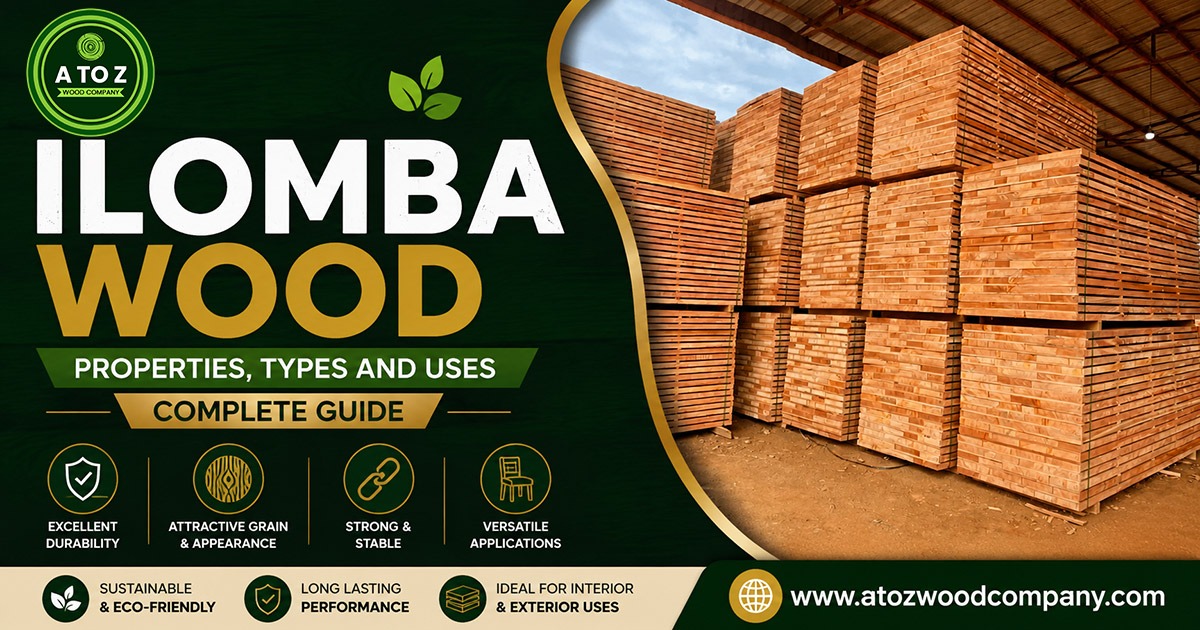
Ilomba is a popular African commercial timber valued for its light weight, smooth appearance, and excellent workability. It’s an affordable, non-durable wood commonly used in interior and industrial applications. Ilomba is obtained from a tree called Pycnanthus angolensis in the Myristicaceae (nutmeg) family. It is also sometimes called African nutmeg.
Ilomba is commonly used for interior woodworking, plywood manufacturing, furniture parts, and decorative veneers. Though it is not naturally durable and is not generally used in outdoor applications, its ease of machining and affordability make it suitable for a wide range of indoor applications.
Looking to buy premium, 100% sustainable Ilomba Wood timber or logs? AtoZ Wood Company is a fast-growing, Cameroon-based global exporter of commercial-grade Ilomba timber sourced from responsibly managed African forests. Contact us today!
Physical Properties of Ilomba Wood
Appearance
Ilomba is known for its clean and uniform appearance. The heartwood color ranges from pale pinkish-brown and creamy yellow-brown to light grey-brown. The sapwood is lighter-colored but not clearly distinguishable from the heartwood. This uniform color variation makes it ideal for modern interiors.
Illoma wood has a straight or slightly interlocked grain, medium to coarse texture and moderate natural lustre. Machining leads to an even, smooth surface.
Its attractive, clear appearance makes Ilomba particularly favored for veneers, interior panelling, plywood, mouldings, and decorative furniture parts.
Physical and Mechanical Properties
Ilomba is lighter than most hardwoods. Despite its relatively low weight, it offers a perfect balance of strength and dimensional stability for many interior applications.
Key characteristics include:
- Lightweight and easy to handle, transport
- Moderate bending strength
- Dried Ilomba has good dimensional stability
- Fast drying rate
- Excellent machinability
- Good response to gluing, nailing, and screwing
Durability and Treatment
One of Ilomba’s weaknesses is its lack of natural durability. Untreated wood provides nearly zero resistance to fungal decay and insect attacks, particularly in outdoor or humid environments.
Fortunately, Ilomba is highly responsive to preservatives, making it easier to pressure treat to improve durability and resistance.
Ilomba’s Workability
Because of its soft structure and light weight, Ilomba is extremely easy to machine. It responds well to both hand and power tools, producing smooth surfaces with minimal defects. It also sands, glues, stains, and paints very well.
Manufacturers favor Ilomba for its outstanding workability, as it:
- Cuts easily with little tool wear or blunting
- Produces clear finishes
- Accepts adhesives and paints effectively
- Holds nails and screws well (no predrilling needed)
- Peels easily into veneer (no steaming required)
These physical qualities make Ilomba a preferred option for quick, high-volume manufacturing where cost and ease of processing are important.
Types of Ilomba Timber Products
Ilomba has only one known species. Commercially, the wood is sold and used in several forms, including:
Ilomba Logs
Round logs are commonly used for firewood, sawmilling, veneer peeling, and plywood construction.
Sawn Timber
Kiln-dried or air-dried boards are available in various sizes and are commonly utilized for interior furniture making, interior joinery, and woodworking projects.
Veneers
Ilomba is widely used for making decorative veneer sheets for plywood faces, furniture, doors, cabinetry, and architectural panels.
Plywood
As a lightweight wood with good adhesion characteristics, Ilomba makes an excellent core material for plywood.
Common Uses of Ilomba Wood
Ilomba is an affordable wood with an attractive appearance and superb workability, making it suitable for numerous interior applications. It’s not commonly used in outdoor projects due to poor rot resistance.
Furniture Manufacturing
Ilomba is constantly used for making strong and attractive interior furniture, cabinets, wardrobes, beds, shelves, and premium tables.
Interior Joinery
Interior doors, window frames, gates, mouldings, trim, skirting boards, handles, and wall panelling.
Decorative Veneers
The wood’s uniform grain and impressive colour gradient make it a brilliant choice for decorative veneers for furniture such as beds and tables, doors, and interior design.
Plywood Production
Ilomba is widely used for making high-quality, lightweight commercial plywood for general interior use.
Packaging and Utility Products
As a lightweight wood with a soft structure, Ilomba is also suitable for crates, boxes, packing material, and other utility materials.
Ilomba Wood: Pros & Cons
Wondering if Ilomba is the right wood for your project? Compare its pros and cons here:
Pros:
- Lightweight and easy to handle
- Excellent workability and machining
- Good response to glues and finishes
- Attractive, uniform appearance
- Cost-effective compared to most African hardwoods
Cons:
- Not durable
- Cannot be used outdoors without treatment
Conclusion
Ilomba wood is the perfect choice if you’re seeking affordability, ease of working, and decent performance, making it one of Africa’s most popular commercial hardwoods for interior applications. While it is not naturally durable for outdoor use, it responds very well to chemical treatment. Ilomba’s excellent machining, attractive finish, and cost-effective availability make it a favourite for interior furniture, cabinetry, veneers, plywood, mouldings, and joinery.
At AtoZ Wood Company, we proudly export 100% sustainably sourced, premium-quality Ilomba logs, sawn timber, and custom wood products suitable for different applications. We deliver Ilomba timber in customer sizes to hundreds of furniture manufacturers, plywood merchants, importers, and construction professionals worldwide. Place your order today!