+237 681 25 6934
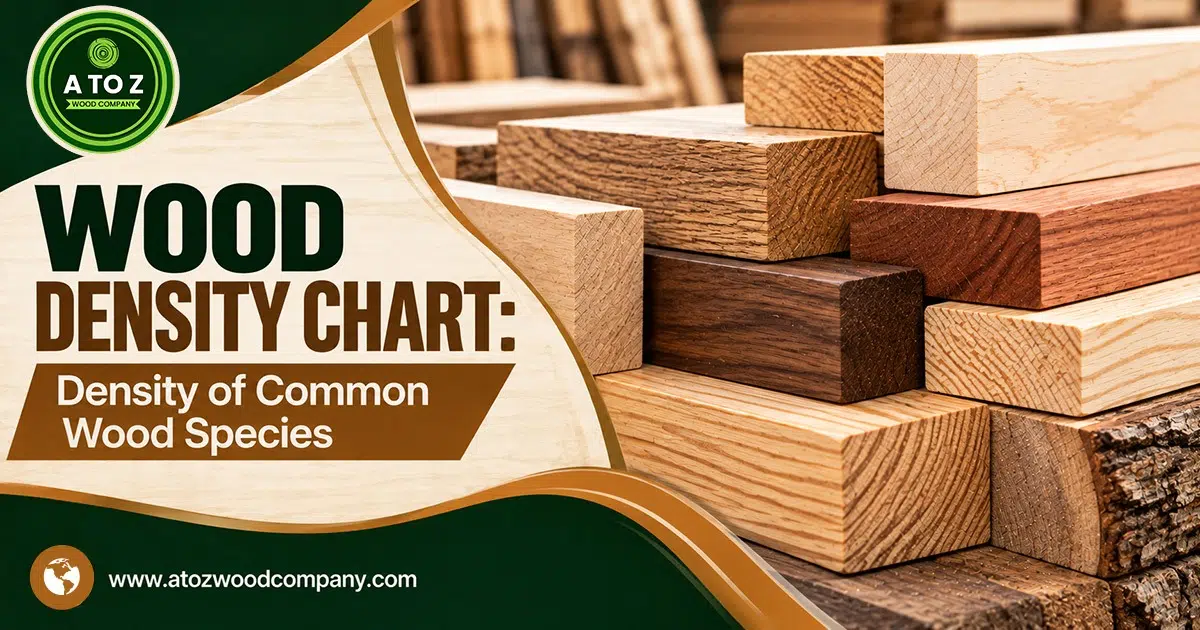
Wood density is one of the most useful properties for comparing timber species. It affects the weight of wood, handling, transportation, machining, hardness, durability, stability, and suitability for different applications. For timber buyers, importers, furniture manufacturers, builders, architects, and woodworkers, understanding density can make it easier to select the right species for a particular project.
This wood density chart provides approximate density values for common hardwood and softwood species, expressed primarily in kilograms per cubic metre (kg/m³). Because wood is a natural material, actual density can vary according to moisture content, growing conditions, geographic origin, age, and testing method.
Density should therefore be used as an important comparison point rather than the only factor when selecting timber.
What Is Wood Density?
Wood density is the mass of wood contained within a specific volume. It is commonly expressed in kilograms per cubic metre (kg/m³) or grams per cubic centimetre (g/cm³).
The basic relationship is:
Density = Mass ÷ Volume
For example, if one cubic metre of a particular timber weighs approximately 700 kg under a specified moisture condition, its density is approximately 700 kg/m³.
Density is important because two timber species can occupy exactly the same volume while having significantly different weights.
A cubic metre of a lightweight species may weigh only a few hundred kilograms, while a cubic metre of a dense tropical hardwood can weigh well over 900 kg depending on its moisture content.
Wood Density Chart in kg/m³
The following table provides approximate reference values for commonly used timber species. Values should be treated as general reference ranges rather than guaranteed commercial specifications.
| Wood Species | Botanical Name | Approx. Density (kg/m³) | Category | Common Uses |
|---|---|---|---|---|
| Balsa | Ochroma pyramidale | 100–200 | Hardwood | Models, lightweight applications |
| Ayous | Triplochiton scleroxylon | 300–400 | Hardwood | Furniture, mouldings, interiors |
| Okoume | Aucoumea klaineana | 350–450 | Hardwood | Plywood, furniture, interiors |
| Spruce | Picea spp. | 400–500 | Softwood | Construction, furniture, panels |
| Pine | Pinus spp. | 450–600 | Softwood | Construction, furniture, flooring |
| Western Red Cedar | Thuja plicata | 350–500 | Softwood | Cladding, decking, outdoor work |
| Douglas Fir | Pseudotsuga menziesii | 500–600 | Softwood | Construction, beams, structural work |
| African Mahogany | Khaya spp. | 500–650 | Hardwood | Furniture, doors, joinery |
| Sapele | Entandrophragma cylindricum | 600–700 | Hardwood | Furniture, doors, flooring |
| Teak | Tectona grandis | 600–750 | Hardwood | Decking, furniture, outdoor construction |
| Iroko | Milicia excelsa | 600–750 | Hardwood | Decking, furniture, construction |
| Oak | Quercus spp. | 650–750 | Hardwood | Flooring, furniture, construction |
| Ash | Fraxinus spp. | 650–750 | Hardwood | Flooring, furniture, handles |
| Beech | Fagus spp. | 650–750 | Hardwood | Furniture, flooring, joinery |
| Walnut | Juglans spp. | 600–700 | Hardwood | Furniture, interiors, decorative work |
| Merbau | Intsia spp. | 750–900 | Hardwood | Decking, flooring, heavy construction |
| Doussie | Afzelia spp. | 700–850 | Hardwood | Flooring, decking, furniture |
| Padauk | Pterocarpus spp. | 700–850 | Hardwood | Furniture, flooring, decorative work |
| Wenge | Millettia laurentii | 800–900 | Hardwood | Flooring, furniture, interiors |
| Azobé | Lophira alata | 850–1,050 | Hardwood | Heavy construction, marine work |
| Ebony | Diospyros spp. | 900–1,200+ | Hardwood | Specialty furniture, instruments, decorative work |
Note: These figures are approximate. Density varies within and between trees and can change substantially depending on moisture content and measurement method. Commercial specifications should always be confirmed using the relevant technical data sheet.
Wood Density Chart: Understanding the Numbers
Wood density is not one fixed number for every piece of timber from a particular species.
A species may have different published density values because different sources measure wood under different conditions.
For example, a timber reference may report:
- Green density
- Air-dry density
- Density at 12% moisture content
- Oven-dry density
- Basic density
- Specific gravity
These values should not be compared directly without checking the measurement conditions.
Why Moisture Content Matters
Freshly harvested wood can contain a considerable amount of water. As timber dries, its mass decreases and its dimensions can change.
Consequently, the density of freshly harvested timber can be considerably different from the density of kiln-dried timber.
For this reason, a wood density chart should ideally identify the moisture condition associated with each value.
For many commercial comparisons, density around 12% moisture content is commonly used as a reference for air-dried wood, although actual specifications vary according to the application and market.
Different Ways of Measuring Wood Density
Green Density
Green density refers to the density of wood when it contains a relatively high amount of moisture, typically close to its condition after harvesting.
Because water contributes significantly to mass, green density can be much higher than the density of dried wood.
Air-Dry Density
Air-dry density refers to wood that has been allowed to dry naturally until it reaches an equilibrium moisture content with its surrounding environment.
The actual moisture content depends on temperature, relative humidity, location, and storage conditions.
Density at 12% Moisture Content
Density at approximately 12% moisture content is frequently used for comparing timber properties because it provides a relatively standardized reference point.
However, it should not be assumed that every timber species or every technical source uses exactly the same test conditions.
Oven-Dry Density
Oven-dry density is determined after removing essentially all moisture from a wood sample under controlled laboratory conditions.
This can be useful for scientific comparison but does not represent the actual weight of timber being transported or installed at normal service moisture levels.
Basic Density
Basic density generally relates oven-dry mass to the green volume of the wood.
It is particularly useful in forestry and scientific applications because it provides information about the amount of dry wood substance relative to its green volume.
Hardwood vs Softwood Density
Hardwood and softwood are botanical classifications rather than simple descriptions of weight or hardness.
Hardwoods generally come from broadleaf trees, while softwoods generally come from coniferous trees.
Although many hardwood species are denser than many softwoods, there are important exceptions.
For example, balsa is botanically a hardwood but is extremely lightweight. Some softwoods can also have relatively high density compared with certain hardwood species.
Therefore, it is incorrect to assume:
Hardwood = always heavy
or
Softwood = always lightweight
Actual density depends on the individual species and growing conditions.
What Is the Densest Wood?
Some of the world’s densest commercially known woods can have densities approaching or exceeding 1,000 kg/m³ under certain measurement conditions.
Examples of relatively dense commercial timber species include:
- Ebony
- Azobé
- Wenge
- Merbau
- Doussie
- Some species of rosewood
- Certain other tropical hardwoods
High-density timber is often associated with high hardness and good wear resistance, but density alone does not determine durability or structural performance.
A dense species may also be more difficult to machine and may require sharper tools and more careful processing.
Lightweight Wood Species
Low-density timber can be useful when weight reduction is important.
Examples include:
- Balsa
- Ayous
- Okoume
- Some spruce species
- Some cedar species
- Certain pine species
Lightweight timber can be useful for:
- Interior furniture
- Decorative panels
- Packaging
- Plywood
- Models
- Lightweight construction
- Boats and marine components
- Acoustic applications
- Carving
However, the appropriate species depends on the required strength, durability, stability, appearance, and environmental conditions.
Why Wood Density Matters When Buying Timber
Density becomes particularly important when purchasing timber in commercial quantities.
A buyer purchasing 20 m³ of lightweight timber and another buyer purchasing 20 m³ of dense hardwood may have significantly different shipment weights even though the volume is identical.
This can affect several parts of the supply chain.
1. Shipping Weight
Density can help buyers estimate the approximate mass of a timber shipment.
This is especially useful for international shipments where container weight limits must be considered.
2. Handling
Dense timber can be substantially heavier to move manually or mechanically.
Warehouses, factories, and construction sites may therefore need suitable lifting equipment.
3. Transportation Costs
Where freight costs are influenced by shipment weight, density can become an important commercial consideration.
However, actual freight calculations should be based on the final packed shipment weight rather than density alone.
4. Product Selection
A dense timber may be desirable for applications requiring wear resistance and substantial weight, while a lightweight species may be preferred when ease of handling is more important.
5. Machining
Higher-density woods can require more cutting force and may cause greater tool wear.
Lower-density species can generally be easier to machine, although grain structure and extractives also influence workability.
How to Calculate Timber Weight Using Density
The basic calculation is:
Mass = Density × Volume
For example, assume a timber species has an estimated density of:
650 kg/m³
If the shipment contains:
10 m³
then:
650 × 10 = 6,500 kg
The estimated wood mass would therefore be approximately:
6,500 kg
This is a simplified estimate.
The actual shipment weight can differ because of:
- Moisture content
- Packaging
- Pallets or supports
- Strapping
- Processing
- Individual density variation
- Product dimensions
- Measurement tolerances
For commercial shipping, the final verified shipment weight should always be used.
Wood Density and Timber Volume
Timber volume and timber density answer two different questions.
Volume tells you how much physical space the timber occupies.
Density tells you how much mass is contained in that volume.
For example, two shipments may each contain 25 m³ of timber, but they can have very different weights if the species have different densities.
This is why timber buyers should consider both CBM volume and estimated density when planning transportation.
For international timber purchasing, it is also important to distinguish between:
- Gross volume
- Net volume
- Packaged volume
- Actual shipment weight
Accurate measurement is particularly important when purchasing logs, sawn timber, slabs, decking, flooring, and other wood products.
Wood Density and Strength
Density is often correlated with certain mechanical properties, but it should not be treated as a direct measurement of strength.
A denser wood can often have greater hardness or resistance to indentation, but strength also depends on:
- Grain direction
- Grain angle
- Defects
- Moisture content
- Growth rate
- Knots
- Species anatomy
- Loading direction
- Sample size
- Testing method
Therefore, engineers and structural professionals should use species-specific mechanical property data rather than relying on density alone.
Wood Density and Hardness
Wood density and hardness are related but are not identical properties.
Hardness describes the resistance of wood to indentation or penetration, while density describes mass per unit volume.
A dense species may be hard, but hardness is influenced by anatomical structure as well as density.
This distinction is particularly important when selecting timber for:
- Flooring
- Decking
- Stairs
- Workbenches
- Heavy-use furniture
- Handles
- Industrial applications
Wood Density and Durability
Density should also not be confused with natural durability.
Some dense hardwoods have excellent resistance to decay and insects, but density alone does not guarantee durability.
Natural durability depends on factors including:
- Extractives
- Cell structure
- Heartwood properties
- Moisture exposure
- Fungal resistance
- Insect resistance
- Installation conditions
A timber species should therefore be selected based on the complete set of performance requirements.
African Wood Species and Density
Africa is an important source of commercial hardwood species used for furniture, flooring, decking, construction, doors, joinery, marine applications, and other timber products.
Frequently traded African species include:
- Iroko
- Sapele
- African Mahogany
- Ayous
- Okoume
- Okan
- Azobé
- Doussie
- Padauk
- Wenge
- Beli
- Movingui
- Moabi
- Ilomba
- Makore
Density varies between species and even between individual pieces of the same species.
For buyers sourcing African timber, density should therefore be considered alongside durability, grain, colour, dimensional stability, availability, processing requirements, certification, and intended end use.
For commercial timber sourcing and wood products, buyers can also visit AtoZ Wood Company to review available timber and wood product categories.
How Density Can Help Choose Timber for Different Applications
Furniture
Furniture manufacturers may select medium- to high-density species when they need:
- Good wear resistance
- Machinability
- Structural integrity
- Attractive appearance
- Long service life
However, weight can also matter for furniture that needs to be frequently moved.
Flooring
Flooring is exposed to repeated foot traffic, so density and hardness can be useful indicators when comparing potential species.
Dense hardwoods are frequently considered for demanding flooring applications, although dimensional stability and finishing characteristics are equally important.
Decking
Outdoor decking requires consideration of:
- Density
- Natural durability
- Moisture resistance
- Dimensional stability
- Grain
- Maintenance requirements
Density alone should never be used to determine whether a species is suitable for exterior applications.
Construction
Construction timber must be selected according to the required structural properties and relevant standards.
Density can provide useful background information, but structural design should rely on tested mechanical properties and applicable engineering specifications.
Marine Applications
For marine and water-exposed applications, buyers should consider density together with:
- Decay resistance
- Marine-borer resistance
- Water exposure
- Dimensional stability
- Mechanical properties
Some dense tropical hardwoods are used in demanding outdoor and marine environments, but suitability must be confirmed for the specific application.
Factors That Cause Wood Density to Vary
Even within one species, density can vary.
Important factors include:
Tree Age
Wood formed at different stages of a tree’s growth can have different characteristics.
Growing Conditions
Soil, rainfall, climate, sunlight, competition, and other environmental factors can influence wood properties.
Geographic Origin
The same species growing in different regions can exhibit variation in density and other characteristics.
Moisture Content
Water contained in the wood directly affects its measured mass and therefore its density.
Heartwood and Sapwood
Heartwood and sapwood can differ in chemical composition and physical properties.
Growth Rate
Fast- and slow-growing trees can produce wood with different anatomical characteristics.
Is Higher Density Always Better?
No.
The best density depends on the intended application.
A high-density timber may be excellent for heavy-duty flooring or outdoor construction but unnecessarily heavy for lightweight furniture.
Likewise, a low-density wood may be excellent for interior panels but unsuitable for an application requiring high wear resistance.
The right timber should be selected according to the complete performance requirement.
Wood Density vs Specific Gravity
Wood density is commonly reported in kg/m³, while specific gravity is a dimensionless ratio comparing the density of wood with the density of water under specified conditions.
The two measurements are related but are not interchangeable without considering the test basis.
Specific gravity is widely used in wood science because it provides a convenient way to compare wood substance density between species.
How to Use a Wood Density Chart Correctly
When comparing species using a wood density chart, check the following:
- Species name – Make sure you are comparing the correct botanical species.
- Moisture content – Check whether the density is green, air-dry, oven-dry, or at approximately 12% moisture content.
- Units – Confirm whether the value is expressed in kg/m³ or g/cm³.
- Source – Use reliable technical references.
- Application – Consider whether you need lightweight, medium-density, or heavy timber.
- Other properties – Check durability, strength, hardness, stability, and workability.
- Commercial specification – For an actual purchase, confirm the supplier’s technical specifications.
Frequently Asked Questions About Wood Density
What is wood density?
Wood density is the mass of wood contained within a specific volume. It is commonly expressed in kg/m³ or g/cm³.
What is the average density of wood?
There is no single average density that represents all wood. Different species can range from very lightweight woods below 200 kg/m³ to very dense hardwoods exceeding 1,000 kg/m³ under some measurement conditions.
Which wood has the highest density?
Some ebony, ironwood-type, and other exceptionally dense species can have densities around or above 1,000 kg/m³ depending on species and measurement conditions. Density values should always be checked against a specified moisture content and testing method.
Is hardwood always denser than softwood?
No. Hardwood and softwood are botanical classifications. Some hardwoods are extremely lightweight, while some softwoods can have relatively high density.
What is wood density measured in?
Wood density is commonly measured in kilograms per cubic metre (kg/m³) or grams per cubic centimetre (g/cm³).
Why does moisture content affect wood density?
Moisture adds mass to wood. As timber dries, water is removed, reducing its mass and often changing its volume. Consequently, measured density depends on moisture condition.
What is the density of teak?
Teak is generally considered a medium- to high-density hardwood, with commonly reported air-dry values around the 600–750 kg/m³ range. Actual values vary according to source, origin, moisture content, and testing method.
What is the density of pine?
Pine density varies substantially between species. Many commercial pine species fall approximately within the 450–600 kg/m³ range at commonly referenced moisture conditions.
Does higher density mean stronger wood?
Not necessarily. Density can correlate with some mechanical properties, but strength also depends on grain, defects, moisture content, species anatomy, and loading direction.
How do I calculate the weight of timber?
Multiply density by volume:
Mass = Density × Volume
For example, 5 m³ of timber with an estimated density of 600 kg/m³ would have an estimated wood mass of approximately 3,000 kg.
Why can two sources give different density values for the same wood?
Different sources may measure samples at different moisture contents, use different testing methods, or study wood from different geographic regions or growing conditions.
Is density important when importing timber?
Yes. Density can help buyers estimate shipment weight and compare species, but actual shipment weight should account for moisture content, packaging, processing, and the verified weight of the finished shipment.
Final Thoughts on Wood Density
A wood density chart is a useful starting point for comparing timber species and understanding how different woods behave in terms of weight and handling. However, density is only one part of timber selection.
When choosing wood for furniture, flooring, decking, construction, joinery, marine applications, or international trade, also consider moisture content, durability, hardness, strength, dimensional stability, workability, appearance, availability, certification, and the intended end use.
Most importantly, always check the measurement basis behind a published density figure. A value measured on green wood cannot be directly compared with an oven-dry value or a value measured at 12% moisture content.
For commercial timber purchasing, species-specific technical data and supplier specifications should be used alongside a general wood density chart to make accurate decisions.
Use density as a guide—but select timber based on the complete set of properties required for the application.