+237 681 25 6934
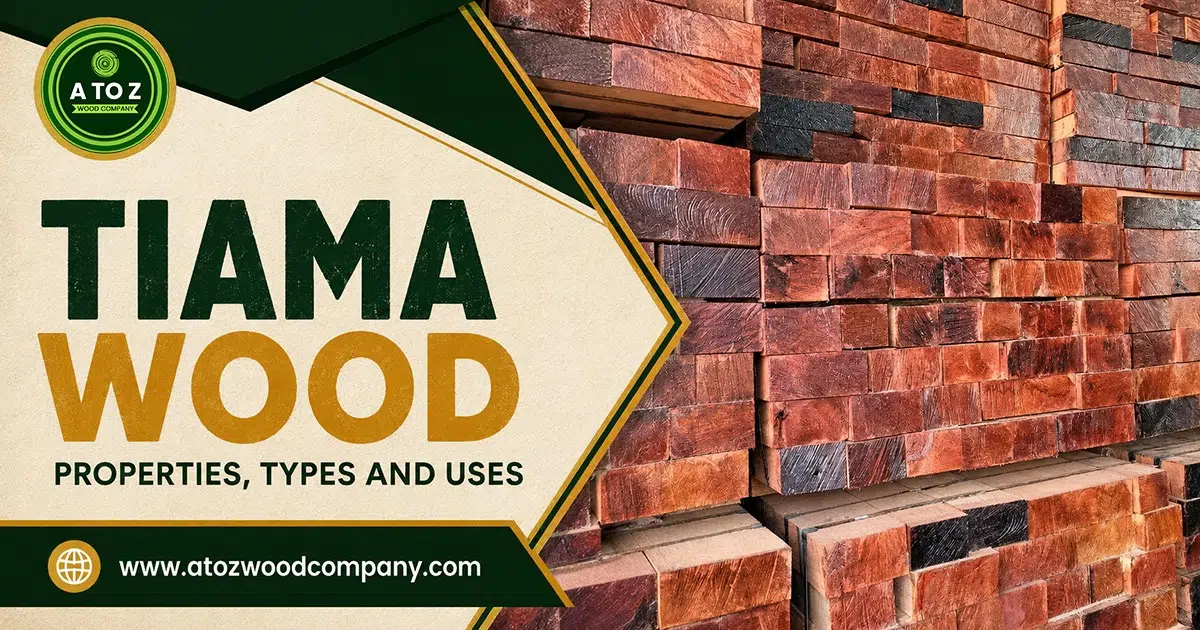
Tiama wood, with scientific name Entandrophragma angolense, is an exotic, highly versatile African tropical hardwood procured from the large Entandrophragma angolense tree in the prestigious Meliaceae (Mahogany) family. Often sold and used under various regional names such as Edinam in Ghana, Gedu Nohor in Nigeria, and Mukusu in Uganda, this species shares physical similarities with genuine mahogany and is commonly used as its local alternative.
When you partner with AtoZ Wood Company, you can order Tiama timber in customized sizes with the assurance of premium-quality, FSC certification and on-time delivery with great after-service support. This article explores the properties, types and applications of Tiama wood in detail.
Core Physical and Mechanical Properties
Tiama is a medium-density tropical hardwood prized for its perfect combination of workability, visual appeal and structural strength.
- Density and Weight: Properly seasoned Tiama has a density of approx. 540 to 640 kg/m³.
- Hardness: With a Janka Hardness rating of around 940 lbf, Tiama is moderately hard with decent resistance to impact and general wear. This makes it easy to handle and work with without compromising the structural integrity of woodworking projects.
- Dimensional Stability and Shrinkage: Tiama has moderate shrinkage. While it dries rapidly, it may slightly warp if kiln temperatures are not adjusted properly. Fully dried timber has exceptional dimensional stability.
- Natural Durability: Tiama is officially a Class 3 durable wood, which means it’s moderately durable against fungal decay. However, it has good resistance to dry-wood borers.
- Treatability: The heartwood can be difficult to treat with chemicals. This is why it is commonly recommended for interior and covered outdoor applications. Direct contact with soil or exposure to moisture without treatment can lead to significant damage.
Visual Appearance and Grain Pattern
The unique appearance of Tiama is one of its notable features. The wood features dark brown color with high natural chatoyance, which increases its appeal.
The stark, brownish color of Tiama heartwood clearly distinguishes it from creamy white or light greyish sapwood. When freshly cut or sawn, the heartwood is a pale pinkish-brown or light red but, with time and exposure, it matures beautifully into a dark rich, golden reddish-brown mahogany-like hue.
The grain in Tiama is primarily interlocked, producing a unique ribbon striping pattern when quartersawn. The texture is medium-to-coarse with a low-to-medium natural luster, providing a naturally striking appearance and clear surface finish for decorative applications.
Commercial Types of Tiama
While Tiama is officially a single species, various botanical and geographic variations are traded globally:
- Standard West African Tiama (Entandrophragma angolense): Sourced primarily from rainforests in the Ivory Coast and Ghana, this is the most popular species and one that yields the largest trees with straight, highly consistent trunks. It is primarily favored for high-quality veneer.
- Darker Acuminata Variant (E. congoense var. acuminata): Found within the jungles of Central Africa and the Congo basin, this species offers a slightly darker, redder wood with a typically fine texture. It looks similar to Sapele wood.
- Quartersawn vs. Flatsawn Selections: The demand and availability of Tiama lumber depends on the cut. Quartersawn Tiama is a highly valued, high-prized variant characterized by prominent, parallel ribbon figures. It is used extensively in premium cabinetmaking and musical instruments. Flatsawn Tiama is favored for general woodworking and wall paneling.
Principal Uses of Tiama Wood
Because of its perfect balance of attractive appearance, structural integrity, and easy workability, Tiama is highly valued across multiple applications and industries:
- Premium Sliced Veneers and Plywood
Tiama is most commonly used for producing clear, decorative veneer panels. The straight, large logs of Tiama yield large sheets free of knots. These sheets are extensively used in furniture, decorative panels, flush doors, and high-grade plywood faces.
- Furniture and Cabinetmaking
Because of its mahogany-like appearance and features and excellent workability, Tiama is widely used to build luxury interior furniture, dining tables, bedroom furniture, and high-end cabinetry. Maintaining a 15-degree cutting angle prevents tearing and helps achieve a uniform, mirror-like stained finish.
- Architectural Joinery and Millwork
Tiama’s superior structural stability makes it perfect for interior woodworking, including solid cabinets, wood floors, doors, window frames, heavy-duty casings, and staircases.
- Exterior Carpentry and Cladding
Tiama is occasionally used for covered building facades, external shutters, doors, siding, and other construction. It must be treated with proper water-repellent sealants before using outdoors.
- Specialty Applications and Shipbuilding
In the marine sector, Tiama is often used for boat interiors, decks, hull planks, and high-end cabin paneling due to its excellent strength-to-weight ratio. Its natural acoustic properties make Tiama popular for constructing musical instrument bodies, such as guitars.
Conclusion
Tiama represents a balanced timber choice that offers the luxury aesthetic of genuine mahogany while remaining a highly workable, strong and stable choice for modern woodworking. It is a versatile wood that finds applications across both interior and exterior projects, though resistant treatment is a must when using outdoors.
At AtoZ Wood Company, we sell premium-quality, FSC-certified Tiama timber and fresh logs with worldwide export and guaranteed best wholesale price. Contact us today to discuss your requirements.