+237 681 25 6934
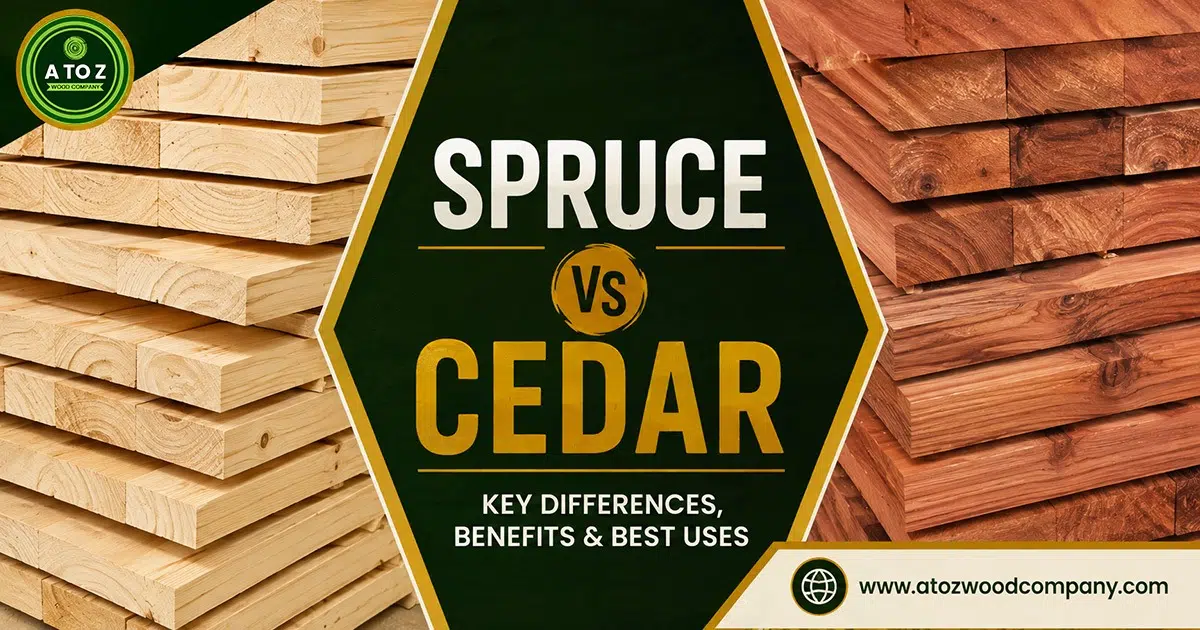
If you’re seeking the perfect timber for your next project, both spruce and cedar are excellent choices. At AtoZ Wood Company, we believe that understanding the individual properties, workability and best use cases of each wood species is important for making an informed choice. In this article, we tackle one of the most debated questions in the woodworking space: which is better: Spruce or Cedar?
While both are classified as softwoods, they have remarkably different physical properties, appearance, and applications. Let’s take a deep look into the individual characteristics of each wood.
Spruce vs Cedar: Visual Aesthetics
Spruce and cedar have exactly opposite colors, making them easily distinguishable at first glance.
Spruce: Light, Tight, and Contemporary
Spruce features a creamy white to a pale yellow heartwood, giving it a clean, minimalist appearance. The grain is straight, tight, and uniform. It is recognized for its sleek, modern appearance.
Common Spruce species include:
- Norway Spruce (Picea abies)
- Blue Spruce (Picea pungens)
- White Spruce (Picea glauca)
- Black Spruce (Picea mariana)
- Sitka Spruce (Picea sitchensis)
- Serbian Spruce (Picea omorika)
Cedar: Rich, Rustic, and Aromatic
Cedar, on the other hand, boasts a fairly dark color profile, ranging from deep yellowish to reddish-brown. The grain ranges from straight to varied, depending on the species. It is known for its famous rustic, classic style.
There are four core (true) species of Cedar:
- Cedar of Lebanon (Cedrus libani)
- Atlas Cedar (Cedrus atlantica)
- Deodar Cedar (Cedrus deodara)
- Cyprus Cedar (Cedrus brevifolia)
Other variants (not true cedar) include
- Western Red Cedar (Thuja plicata)
- Eastern Red Cedar (Juniperus virginiana)
- Incense Cedar (Calocedrus decurrens)
- Northern White Cedar (Thuja occidentalis)
- Spanish Cedar (Cedrela odorata)
Spruce vs Cedar: Physical Attributes
Spruce
Spruce stands out for its extraordinary strength-to-weight ratio. Despite being lightweight, it is extremely strong and rigid. This ensures excellent structural stability, allowing it to bend without breaking.
However, its pale color and high porosity make spruce highly susceptible to staining from exterior elements (moisture, UV rays, etc.). The color gets a darker, golden-amber patina over time.
Cedar
Beyond its looks, cedar is also famous for its distinct, spicy aroma that comes from its natural oils. These also make the wood practically impregnable against insects, termites, and moisture decay. As a soft and lightweight wood, it is easy to cut and shape. However, it is more susceptible to scratches and dents than stiffer spruce.
Both species possess excellent acoustic properties, making them suitable for guitars and other musical instrument bodies.
Spruce vs Cedar: Strength & Durability
If you’re buying wood for an outdoor project, the environmental factors must play a crucial role in the selection process. This is where the gap between spruce and cedar becomes wider.
Cedar
For outdoor applications, cedar is definitely the best choice. Its natural cellular composition and oils make it extremely resistant to rotting, decay, and moisture. It requires zero chemical treatments. The wood is completely stable even when constantly exposed to rain, snow, or intense weather elements. This means it resists twisting, splitting, or warping over constant outdoor use. It is the perfect choice for outdoor construction, decks, siding, fencing, shingles, pathways, and patio furniture.
Spruce
Spruce, while stronger and stiffer than cedar, is mostly suitable for indoor framing. It does not do well in outdoor conditions due to a lack of natural oils. Spruce can be highly vulnerable to rot, insect attack, and moisture damage when constantly exposed to soil or rain. If used outdoors, it must be properly pressure-treated with heavy chemicals or meticulously sealed and maintained regularly. For this reason, spruce is recommended to be used primarily for indoor applications.
Spruce vs Cedar: Common Applications
Both spruce and cedar are highly popular softwoods with distinct applications based on their unique appearances and physical properties.
The exceptional strength-to-weight ratio and excellent acoustic properties of Spruce make it a wonderful choice for musical instrument soundboards and bodies, including guitars and pianos. It is an extremely popular wood for
- Internal framing
- Furniture
- Aircraft components
- Paper production
Cedar’s natural resistance to rot and insects makes it a popular choice for outdoor projects. Builders frequently use it for
- Exterior siding
- Shingles
- Decking
- Fencing
- Outdoor furniture
Its pleasant aroma also makes cedar timber popular for lining closets, cabinets and chests.
Making the Right Choice for Your Project
Choose Cedar if you’re looking for a durable wood for an outdoor deck, table, exterior siding, backyard garden bed, patio, or acoustic guitar.
Choose Spruce if you need a reliable, structurally sound wood for interior framing, indoor furniture, architectural trim, or an acoustic guitar or piano.
Conclusion
Ultimately, neither cedar nor spruce is perfect. The right wood depends on the actual application. Each species is specialized in its unique roles. Cedar is a durable, rustic, and aromatic masterpiece, perfectly suited for challenging outdoor applications or sweet, intimate music. Spruce is a cleaner, stiffer, and tool–friendly choice ideal for interior work and musical projects.
At AtoZ Wood Company, we sell both cedar and spruce timber in many forms suitable for a diverse range of commercial and residential projects. Whether you’re ready to buy timber or need help, our team is just one call away.