+237 681 25 6934

Let me tell you—hardwoods are not created equal.
Some woods are like the gym rats of the forest. You hit them with a chisel, and they laugh. Try to nail them, and your tools surrender first.
These are the strongest woods known to humankind—dense, durable, and downright unbreakable. But more than their muscle, these woods carry stories—of resilience, of exotic origins, and of practical power.
As someone who has sourced, processed, and even fought with (yes, fought with) some of the world’s hardest species at AtoZWoodCompany, let me walk you through the elite league of hardwoods.
What Makes a Wood “Hard”?
We often refer to the Janka Hardness Scale, which measures how resistant a wood is to denting and wear. The higher the number, the tougher the timber.
But for builders, woodworkers, and serious buyers like you, it’s not just about the number. It’s about performance—how it holds up in heavy-duty applications, how it behaves under machines, and how long it stays beautiful and intact.
The Global Heavyweight Champions of Hardness
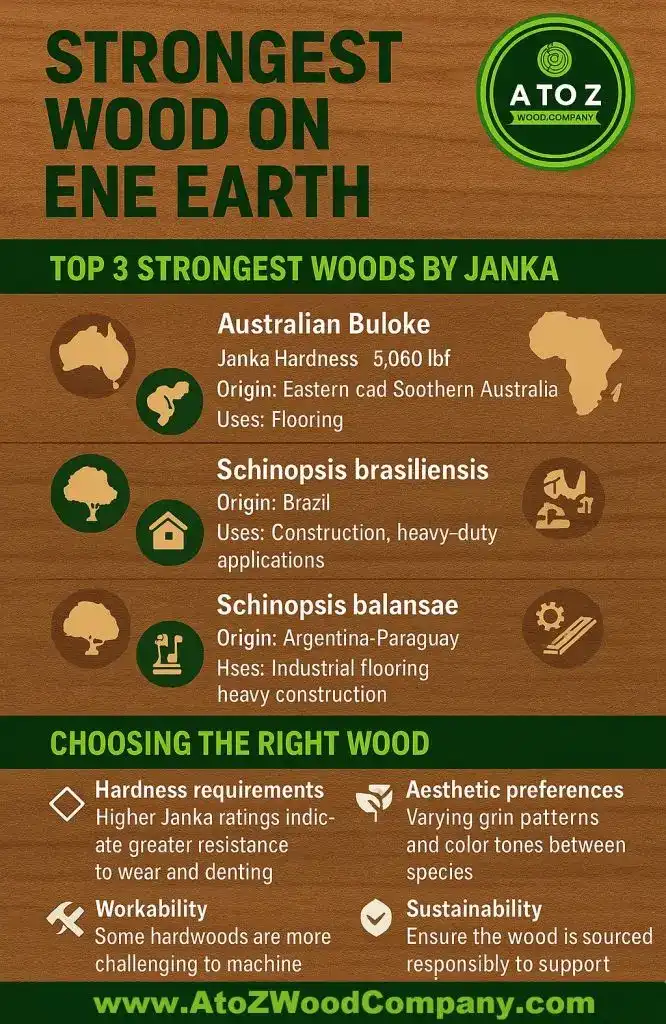
1. Australian Buloke (Janka: 5,060 lbf)
Region: Australia
Nickname: Ironwood Royalty
This is quite possibly the hardest wood in the world. You don’t cut Buloke. You negotiate with it. Its density is so extreme that it’s used in industrial flooring, heavy-wear zones, and military-grade products.
Insider Tip: If you’re buying for structural or anti-wear purposes in high-traffic areas, this is your wood. But warn your carpenter—it eats through saw blades.
2. Lignum Vitae (Janka: ~4,500 lbf)
Region: Central America & Northern South America
Nickname: The Wood of Life
This wood is so dense it sinks in water. Lignum Vitae has natural oils that make it self-lubricating—so it was once used in ship propeller shafts!
Sustainable Insight: It’s a slow-growing species and considered endangered in some regions. At AtoZ, we promote alternative dense woods to protect it while maintaining performance.
3. Snakewood (Janka: 3,800+ lbf)
Region: South America
Nickname: The Most Exotic Performer
With its wild, snakeskin-like grain, it’s both incredibly hard and stunning. This one’s often used in high-end knife handles, bows, and luxury items.
Anecdote: I once had a customer who swore this wood turned a basic pen into a $500 collector’s piece. Not joking.
4. Ipe (Janka: 3,510 lbf)
Region: Central & South America
Nickname: Ironwood
Ipe is popular for decking—and not just for its strength. It’s rot-resistant, bug-proof, and stays smooth for decades.
Pro Tip: It’s a top pick for outdoor luxury builds. We export Ipe regularly to clients in North America and Europe looking for long-term value.
5. Cumaru (Janka: 3,330 lbf)
Region: South America
Nickname: Brazilian Teak
More affordable than Ipe but nearly as tough, Cumaru is like that underdog athlete you shouldn’t underestimate.
The Hardest Woods in the World: What You Really Need to Know
If you’ve ever worked with hardwoods, you know some species don’t just feel tough—they fight back.
They dull your blades, challenge your patience, and if you’re not careful, humble even the most seasoned woodworker. But let’s be honest: when you’re sourcing timber for high-traffic projects, outdoor builds, or long-lasting products, you want that kind of strength. You need wood that can take a beating and still look great doing it.
So let’s talk about the world’s hardest woods—not just by numbers, but by real-life performance. I’ve worked with these woods personally through AtoZWoodCompany, and let me tell you, each one has a personality of its own.
What Does “Hardest Wood” Actually Mean?
You’ve probably heard of the Janka Hardness Scale. It’s the go-to measure for how resistant wood is to denting or wear—basically, how much force it takes to push a steel ball halfway into the wood. The higher the number, the harder the wood.
But here’s the thing: numbers are helpful, but in the real world, context matters just as much.
What’s the project? What’s your climate? Are you working indoors, outdoors, or somewhere rough and rugged? Let’s look beyond the scale and into the real-life impact of these heavy hitters.
Top 10 Hardest Woods in the World
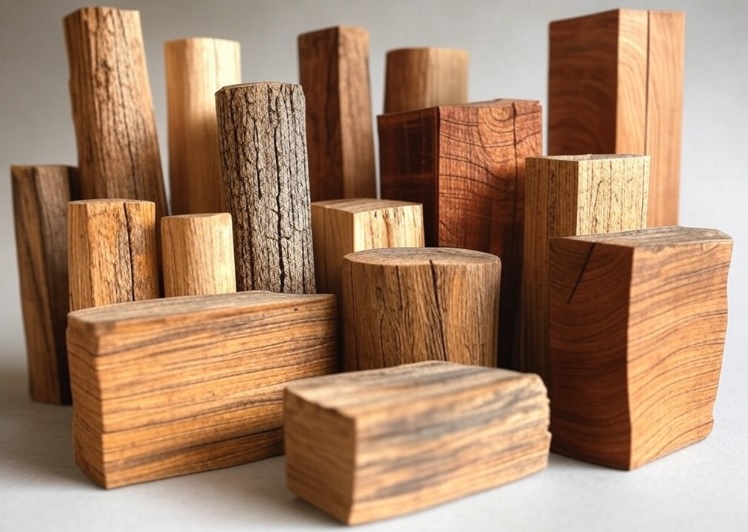
Some are soft and easy to work with—great for carving, indoor furniture, and quick projects. But others? They’re beasts. We’re talking woods so tough they’ll dull your blades, push your tools to the limit, and still come out looking pretty.
If you’re in the timber business—whether you’re sourcing for high-end construction, industrial uses, or exporting to clients who expect nothing but the best—you need to know which woods sit at the top of the hardness scale.
So let’s dive into the Top 10 Hardest Woods in the World, not just by number, but with real insights from the field.
1. Australian Buloke
Janka Hardness: 5,060 lbf
Origin: Australia
Use Case: Flooring, industrial wear surfaces
The Deal: This wood is brutal. It’s so hard it’s practically armor. Great for when nothing else will do—just make sure your tools are up to the challenge.
2. Schinopsis brasiliensis (Brazilian Quebracho)
Janka: ~4,570 lbf
Origin: South America
Use Case: Railroad ties, outdoor applications
The Deal: “Quebracho” means axe-breaker in Spanish. That’s no exaggeration. Very heavy, very dense, and insanely tough.
3. Lignum Vitae
Janka: 4,390–4,500 lbf
Origin: Central & South America
Use Case: Marine bearings, luxury items
The Deal: Naturally oily and self-lubricating. A legend in the world of hardwoods—but endangered in some areas, so sourcing responsibly is key.
4. Pockwood (Guaiacum sanctum)
Janka: 4,390 lbf
Origin: Caribbean & Central America
Use Case: Turned objects, tool handles
The Deal: Often confused with Lignum Vitae. It’s just as hard, dense, and moisture-resistant—great for humid environments and high-wear situations.
5. Snakewood
Janka: ~3,800 lbf
Origin: South America
Use Case: Decorative applications, knife handles
The Deal: Gorgeous and rare, with a snakeskin-like pattern. Great for luxury pieces but difficult to machine and expensive.
6. Quebracho Colorado
Janka: ~3,570 lbf
Origin: South America
Use Case: Flooring, tool handles
The Deal: Not quite as tough as its sibling Quebracho Blanco, but still extremely durable. Great for applications needing density and strength.
7. Ipe (Brazilian Walnut)
Janka: 3,510 lbf
Origin: Central & South America
Use Case: Outdoor decking, boardwalks
The Deal: This is the go-to for premium outdoor builds. It’s fire-resistant, bug-resistant, rot-resistant—and it lasts for decades.
8. Cumaru (Brazilian Teak)
Janka: 3,330 lbf
Origin: South America
Use Case: Decking, heavy-duty flooring
The Deal: Slightly easier to work with than Ipe, but still extremely hard and durable. Offers a balance of strength and value.
9. Cambootie (Sandarac Tree)
Janka: ~3,300 lbf
Origin: Africa
Use Case: Tool parts, furniture
The Deal: Not commonly found on global markets, but a solid performer with excellent resistance properties.
10. Ebony (Gabon Ebony)
Janka: 3,220 lbf
Origin: Africa
Use Case: Musical instruments, fine furniture
The Deal: Deep black, incredibly dense, and gorgeous. Very tough to work with, but prized for high-end applications.
How Many Types of Wood Are There?
If you’ve ever asked, “How many types of wood are out there?” — you’re not alone. It seems like a simple question, right? But the truth? It’s a little more layered (like a nice piece of veneer).
As a timber supplier at AtoZWoodCompany, we get this question from builders, importers, and even curious homeowners who just want to make the right choice for their project. And honestly, we love it—because understanding the types of wood out there helps you make smarter, longer-lasting, and more cost-effective decisions.
So let’s break it down: the categories, the characteristics, and what really matters when choosing wood for your project.
Let’s start with the broad strokes. Wood falls into three main categories:
1. Hardwood
- Source: Deciduous trees (those that lose their leaves)
- Examples: Oak, Mahogany, Teak, Maple, Iroko
- Best for: Furniture, flooring, cabinets, construction, high-end builds
Hardwoods are known for their strength and durability—but not all of them are super dense (balsa, for example, is technically a hardwood but softer than some softwoods!).
At AtoZWoodCompany, we export a ton of hardwoods like Sapele, Zebrawood, and Ipe, especially for clients building luxury interiors, decking, or long-lasting furniture.
2. Softwood
- Source: Coniferous trees (evergreens like pine, fir, cedar)
- Examples: Pine, Spruce, Douglas Fir, Cedar
- Best for: Framing, construction, paneling, outdoor structures
Softwoods grow faster and are generally easier to work with, making them more affordable and widely used in construction. That’s why we offer bulk softwood shipments for large-scale projects across Asia and the Middle East.
Pro Tip: Softwood doesn’t mean “weak.” Douglas fir, for example, is incredibly strong and widely used in structural framing.
3. Engineered Wood
- Source: Manufactured by binding wood fibers, veneers, or strands with adhesives
- Examples: Plywood, MDF, OSB, Laminated Veneer Lumber (LVL)
- Best for: Cabinets, furniture, prefab construction, flooring underlayment
These aren’t naturally occurring, but they’ve become essential in modern building. They offer uniform strength, resistance to warping, and cost efficiency.
While AtoZWoodCompany focuses on natural timber, we often advise clients on where engineered products fit into the picture.
How Many Wood Species Are There?
Now here’s where it gets fun. Globally, there are over 60,000 species of trees, and thousands of those are commercially usable for wood.
Depending on your region and the market you’re in, you might have access to:
- Over 1,000 hardwood species used in trade
- Hundreds of softwoods used in everything from framing to fine furniture
- Dozens of specialty woods that are exotic, rare, or region-specific
At AtoZWoodCompany, we specialize in both exotic tropical hardwoods (like Padauk, Wenge, Bubinga) and locally sustainable species harvested from responsibly managed forests.
What Is the Most Durable Type of Wood?
If that’s you—or your clients—you’re asking the right question: What is the most durable type of wood?
And by “durable,” we’re not just talking about how hard it is. We’re talking about weather-resistance, bug-resistance, lifespan, stability, and good old-fashioned toughness.
At AtoZWoodCompany, we’ve worked with builders putting up seaside resorts in humid climates, furniture makers crafting pieces meant to last generations, and architects who need exterior cladding that can battle the elements and still come out smiling.
So let’s dive into what “durability” really means in the wood world—and which woods are the undisputed champions.
What Makes a Wood Durable?
Durability in wood depends on several factors:
- Resistance to rot and decay (especially important for outdoor use)
- Natural oils and tannins that repel moisture and insects
- Hardness and density (higher = better for wear-and-tear)
- Dimensional stability (doesn’t warp, crack, or expand too much)
- Longevity (some woods naturally last 30–50+ years without treatment)
Durability also depends on the environment. What holds up in dry Arizona might not cut it in coastal Southeast Asia. That’s why we help match the wood to the conditions.
Conclusion: Built to Last, Chosen with Care
There’s something special about working with really tough wood. You feel it the moment your saw hits the grain. It resists, it pushes back—and somehow, that’s exactly what makes it beautiful. These aren’t just materials; they’re workhorses.
Whether you’re building in a humid coastal zone, decking out a high-traffic commercial space, or crafting something meant to last a lifetime, choosing the right wood makes all the difference.
The strongest woods in the earth don’t just survive the elements—they thrive in them. And when you know what you’re working with, you can build with confidence.
At AtoZWoodCompany, we don’t just supply timber—we know timber. We’ve handled it, processed it, and sometimes even wrestled with it. So if you’re looking for strength, beauty, and wood that tells a story, we’re here to help.
Strong timber. Honest advice. Global reach. Let’s build something solid.