+237 681 25 6934
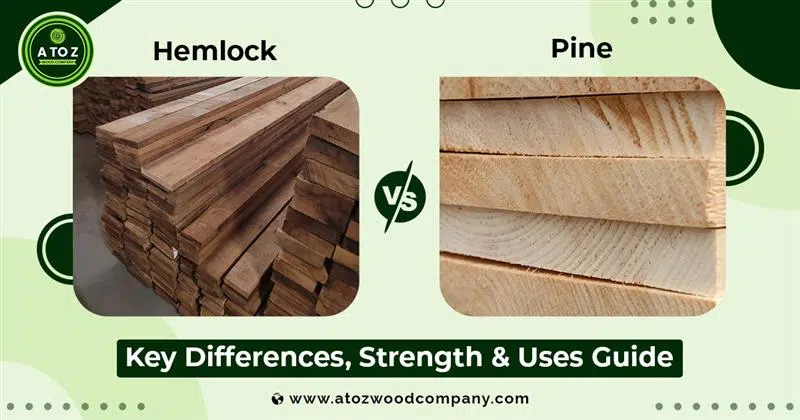
While hemlock and pine wood may appear similar at first glance, these two differ significantly in strength, durability, appearance, workability, and cost.
If you are a builder, contractor, furniture manufacturer, or timber importer looking to make the right choice, this detailed comparison will help you decide which wood suits your project best.
Overview of Hemlock Wood
It is a lightweight softwood primarily sourced from North America and parts of Asia. Western Hemlock is the most commercially used species. It is widely valued in structural framing and industrial applications.
Key Characteristics
-
Color: Light brown with a slight reddish hue
-
Grain Pattern: Straight and uniform
-
Texture: Medium to coarse
-
Density: Moderate (approx. 450 kg/m³)
-
Strength: Good strength-to-weight ratio
-
Resin Content: Low
Advantages
-
Excellent structural performance
-
Stable with minimal warping
-
Takes stain and paint well
-
Good for framing and load-bearing applications
-
Smooth finish when properly planed
Disadvantages
-
Not naturally resistant to decay
-
Low resistance to insects
-
Requires treatment for outdoor use
Hemlock is commonly used in:
-
Structural framing
-
Roof trusses
-
Doors and windows
-
Interior paneling
-
Mouldings
-
Industrial timber components
Overview of Pine Wood
It is one of the most widely used softwoods globally. It grows quickly, making it affordable and easily available. There are many species, including Eastern White Pine, Southern Yellow Pine, and Radiata Pine.
Key Characteristics
-
Color: Pale yellow to creamy white
-
Grain Pattern: Straight but with visible knots
-
Texture: Fine and even
-
Density: Varies by species (400–600 kg/m³)
-
Resin Content: Moderate to high
Advantages
-
Affordable and budget-friendly
-
Lightweight and easy to handle
-
Easy to cut, nail, and glue
-
Good for indoor furniture
-
Widely available
Disadvantages
-
Softer (prone to dents and scratches)
-
Knots may affect structural consistency
-
Needs treatment for outdoor durability
Pine is commonly used in:
-
Furniture manufacturing
-
Interior décor
-
Flooring (treated varieties)
-
Shelving
-
Packaging
-
Construction framing
Hemlock vs Pine: Detailed Comparison
Let’s compare both woods across important decision-making factors.
1. Strength & Structural Performance
When it comes to structural framing, Hemlock generally performs better than standard Pine varieties. It has a more uniform grain structure and fewer knots, which increases its reliability in load-bearing applications.
Southern Yellow Pine, however, is stronger than Hemlock in certain heavy-duty applications due to its higher density.
2. Durability & Outdoor Use
Neither Hemlock nor Pine is naturally highly rot-resistant. Both require pressure treatment for outdoor exposure.
However, treated Pine (especially pressure-treated Pine) is more commonly used for:
-
Decking
-
Fencing
-
Outdoor furniture
Hemlock is less commonly used outdoors unless properly sealed and maintained.
3. Appearance & Grain Pattern
Hemlock has:
-
A cleaner, straighter grain
-
Fewer visible knots
-
More uniform appearance
Pine often contains:
-
Visible knots
-
Rustic aesthetic
-
Color variations
4. Workability & Machining
Pine is easier to machine due to its softness. It cuts, nails, and screws effortlessly. Hemlock, being slightly denser, requires sharper tools but still works well.
For beginners and large-scale furniture production, Pine is often preferred.
5. Cost Comparison
Pine is generally more affordable because:
-
It grows faster
-
It is widely cultivated
-
It has large global supply
Hemlock tends to be slightly more expensive, especially higher grades used in structural applications.
6. Resistance to Warping & Stability
Hemlock is known for dimensional stability. It tends to warp less than lower-grade Pine varieties.
This makes Hemlock a reliable option for:
-
Doors
-
Windows
-
Trim
-
Framing
Choose Pine If You Need:
-
Budget-friendly furniture wood
-
Rustic interior décor
-
Easy-to-work material
-
Outdoor treated lumber
-
Mass production woodworking
Hemlock vs Pine for Furniture
For indoor furniture:
-
Pine is more common due to affordability and ease of machining.
-
Hemlock offers a cleaner look and fewer imperfections.
For premium furniture requiring smooth grain and structural reliability, Hemlock may offer better results. However, Pine remains a top choice for cost-effective furniture production.
Environmental Considerations
Both are softwoods sourced from managed forests. Sustainably harvested timber ensures minimal environmental impact.
When sourcing timber, always choose suppliers that follow:
-
Responsible harvesting practices
-
Sustainable forest management
-
Ethical labor policies
-
Proper kiln drying and treatment
Sustainable sourcing improves durability, reduces waste, and supports eco-friendly construction.
Hemlock vs Pine – Which Is Better?
There is no single “best” wood — it depends entirely on your project requirements.
| Factor | Hemlock | Pine |
|---|---|---|
| Strength | Good | Moderate to High (species dependent) |
| Cost | Moderate | Low |
| Workability | Good | Excellent |
| Appearance | Clean & uniform | Knotty & rustic |
| Outdoor Use | Needs treatment | Commonly pressure-treated |
| Stability | Very stable | Moderate |
Conclusion
Understanding the difference between hemlock and pine helps you select the right timber for strength, budget, durability, and appearance. Both woods serve different purposes in construction and furniture manufacturing.
If you are sourcing timber for bulk supply, commercial projects, or international export, choosing high-quality graded wood from a trusted supplier ensures performance, durability, and long-term value.
Selecting the right wood is not just about cost — it’s about matching the material to the application for maximum efficiency and lifespan.